GENERAL INFORMATION about Athens, HELLAS.
Throughout history, Athens has been one of the most important and influential cities of the western world. The peak of this civilization occurred during the 70-year Golden Age in the fifth century BC. It was during this period that great strives were made in architecture, literature, math, science, philosophy and medicine. History gave witness to some of the most celebrated men of our time including Sophocles, Euripides, Hippocrates, Socrates, Plato, and Aristotle.
Despite its vast history, the Athens of the 20th century is a bustling modern city with overcrowded streets, traffic jams, pollution, and characterless modern cement buildings. The city has been criticized for lack of overall planning during an enormous population growth in the 19th and 20th centuries. When Athens became the Capital of Greece in 1834, it was a mere village of 6,000 residence. The Athens of today is home to 4.5 million people and covers an area of 165 square miles.
Although at first glance the visitor may not see the splendor of ancient Athens, the mental images of an historic civilization come alive with the first glimpse of its most prominent architectural masterpiece, the Acropolis. Athens is a city where past and present coexist, sometimes harmoniously, but more often umharmoniously. This however should not detour the tourist from experiencing some of the most awe-inspiring sights of the Western World.
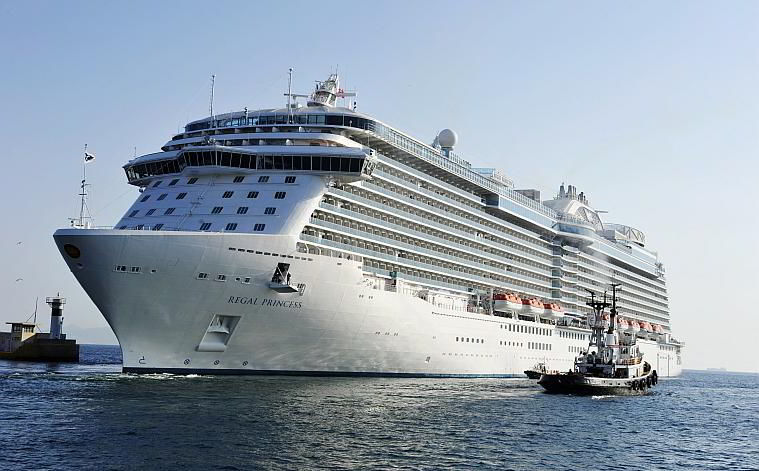
Located 7 miles from the center of Athens, Piraeus has been Athen's port since the early 5th century BC. The city became an economic center in the 1920's with the construction of over 75 steam powered factories. The population has now reached 600,000.
HISTORY: Athens grew to a city of historic importance around the 8th century BC when it became the artistic center of Greece. It continued to flourish and reached its zenith in the 5th century BC. This period was known as the Golden Age of classical Greek culture and produced some of the most influential historical figures of the Western world. Aeschylus, Sophocles, and Euripides wrote tragic masterpieces while Aristophanes satirized contemporary ideals with his comedies. Socrates, Plato, and Aristotle debated the fundamental questions of knowledge and meaning, and early historians such as Herodotus challenged the assumption that gods, not human beings, governed history. Hippocrates developed the science of medicine, and classical architecture and sculpture reached new heights with the construction of the Acropolis and Parthenon.
The end of the Golden Age began with the Peloponnesian War (431 -404 BC) between Athens and Sparta. Athens continued to be a notable cultural center until the 2nd century when the Roman Empire took control of Greece. The city remained the center of Greek education until the fall of Rome to the Byzantine Empire in 476 AD. Emperor Justinian closed Plato's Academy in Athens and the dark ages (Medieval Era) prevailed for the next 500 years.
Athens experienced a pseudo-renaissance around the 12th and 13th centuries but then fell under Turkish rule for the next four centuries. The Greek War of Independence (1821 - 1829) brought the city out of cultural hibernation and in 1834 Athens was proclaimed the capital of the new, independent Greece.
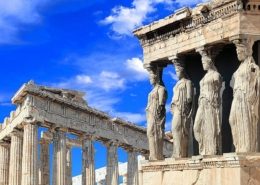
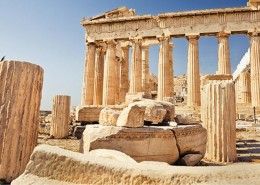
1.Acropolis, one of the great wonders of the world, actually consists of four ancient buildings; the Parthenon, Temple of Athena Nike & the Erechtheion, and the Propyiaea. The acropolis was built during the apex of Greeks Golden Age in the 5th century BC. Throughout history, it has served as a military fortress and religious center. The entrance is on the southwest side at Dionyssiou Areopagitou street. It is a 5 minute climb to where tickets can be purchased. The Acropolis Museum is located on the Acropolis and contains sculptures found in the Acropolis. Areopagus is the ancient supreme court from which St Paul addressed the Athenians in 54 AD, and converted Senator Dionysius who became the first bishop of Athens.
2.Ancient Agora was the administrative center and marketplace of Athens from the 6th century BC to the 6 th century AD. This archaeological site features three remarkable constructions: the Temple of Hephaestus, the best preserved classical temple in Greece; the Odeon of Agrippa the concert hall; and Stoa of Attalos, a multipurpose building now housing the Agora Museum. Pnyx, also located in the Ancient Agora, was the meeting place of the general assembly during the Golden Age. A quorum of 5,000 citizens was necessary to take a vote. It now serves as the location of the Sound and Light show as well as an excellent photo opportunity of the Acropolis.
3.Plaka is the older area of the city located on the north slope of the Acropolis. You can walk the narrow cobblestone streets with winding staircases and old mansions, or take a rest in one of the numerous tavernas. There are also a number of tourist shops as well as a few ancient sites worth visiting. The Tower of the Winds, located in the Plaka area, is one of the most well preserved monuments in Athens. It was built in the 1st century BC and used as a water clock, sun dial, and weather vane. Each of the eight sides of the octagon has a relief depicting the wind that blows from that direction.
4.Panathenaic Stadium was constructed in 1896 for the first modern Olympic Games.
5.The National Gardens are open from Sunrise to Sunset and are located adjacent to Syntagma Square. This delightful garden is a retreat from the noise and heat of the city.
6.Dionysos and Odeon Theaters, are located just below Acropolis Hill. Dionysos once hosted plays of Euripides, Aristophanes, Sophocles, and Aesculus and could hold up to 17,000 spectators. The Odeon of Herold Atticus amphitheater was built in the second century AD. It has been reconstructed and is used during the summer to host Athens Festival performances.
7.Hadrian's Arch was built by the Roman ruler in the 2nd century. The architectural remains as seen from the outside are well preserved.
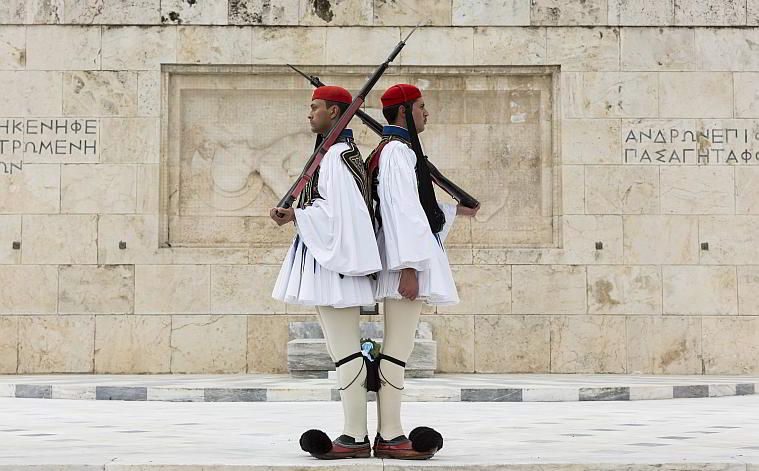
8.The Parliament Building near Syntagma Square has a changing of the guard every hour on the hour. The guards friendly demeanor is as delightful as their attire - Pom-pom-laden clogs, short pleated skirts (foustanela), and pony-tail-tesselled hats. This is the location of Tomb of the Unknown Soldier.
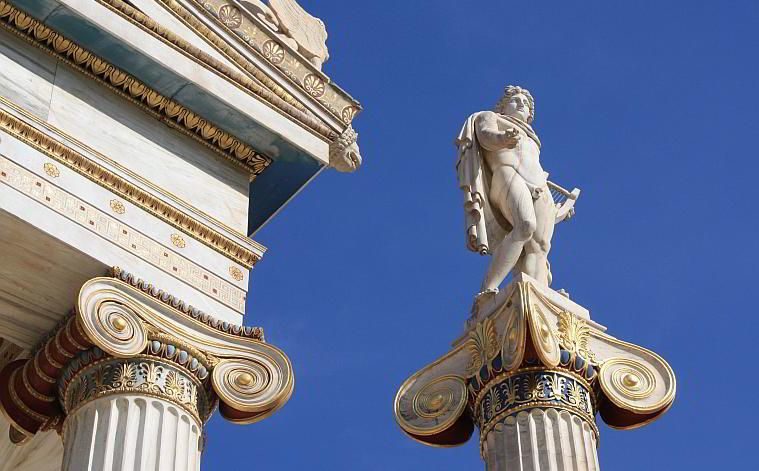
9.Along the impressive street of Akadimias you will find the Athens University, National Library and the Hellenic Academy.
Other sights in Athens
Monastiraki Square is the core of the market area and a great place to bargain for souvenirs. The flea market is located next to the Monastiraki metro station just off Monastiraki square. The best time to visit is Sunday morning.
National Archaeological Museum at 44 Patission St., is one of the largest and best museums of Greek artifacts in the world. It contains archaeological finds from all of Greece, from prehistoric times through the Byzantine period. Descriptions are listed in Greek, English, French, and German.
Little Metropolis, dating back to the 12th century, is one of the most charming churches in Athens. Above the entrance you will find reliefs of figurines and interesting displays of zodiac signs. Beautiful frescos on the outer walls are covered with reliefs dating from the Classical to Byzantine periods.
Mt. Lycabettus, the highest hill in Athens, offers an excellent panoramic view of the city from all sides. The summit, at 912 feet, can be reached by foot, car or funicular which operates from the Kolonaki side of the hill. On the top you will find a tiny 19th century chapel of St George as well as a restaurant.
Benaki Museum contains ancient Greek and Byzantine art, icons, costumes and folk crafts from the islands, and relics from the War of Independence. Descriptions are in Greek and French.
Byzantine Museum is the only museum in Europe concentrating exclusively on Byzantine art. Each room is arranged to look like Greek churches of different eras and the outer wings contain mostly icons. The outer grounds are also worth a visit with beautiful rose gardens, a fountain, and fragments of statues. Descriptions are in Greek and French.
Beyond Athens
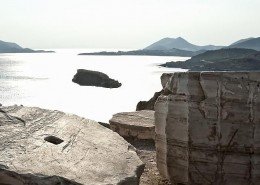
Cape Sounion is located 70 kilometers (43 miles) from Athens at the tip of the Attic peninsula. This is the location of the 5th-century BC Temple of Poseidon. The view from the Temple is spectacular. The original temple was destroyed by Persians in 480 BC, but rebuilt by Pericles in 440 BC Among the remains are 16 doric columns. The lower hill is scattered with remains of the Temple of Athena Sounias, patron goddess of Athens.
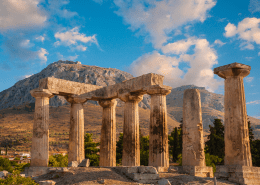
Ancient Corinth is where St. Paul spoke to the Corinthians. A historical place for both the Byzantines and the ancient Greeks. The Corinth Canal is a structure of great importance, as before it was built, ships sailing between the Aegean and Adriatic Seas had to circumnavigate the Peloponnese, adding about 185 nautical miles to their journey. If you want and dare, you can try bungee jumping off this historical canal wall.
Mycenae was settled as early as 2700 BC, but the period of its greatest power came at the close of the Late Bronze Age (1600 BC - 1100 BC). The Mycenae civilization spread throughout the Eastern Mediterranean and became the center of wealth and power. The archaeological discoveries in this area are some of the most celebrated finds in modern history. Some of the most noted ruins include the Tomb of Agamemnon, and the Lion Gate.
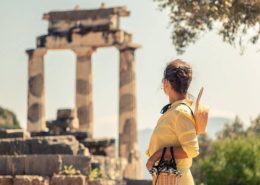
Delphi, located 189 kilometers (118 miles) North of Athens, has served as a sanctuarie (shrine) throughout many periods of Greek history. It was the home of Apollo as well as the most famous oracle of antiquity. The most prominent figures in Greek history have visited this sacred site to hear the prophecy of the oracle. Among its ruins are the Temple of Apollo and Altar of Apolio.
Local Customs.
Tipping: There are no absolute rules for tipping. A 10% tip is expected in most restaurants, services etc.
Local Cuisine: For a starter you will most likely find these three favorites on most menus; taramasalata (a dip or spread made from fish roe), melitsanosalata (made from smoked eggplant), and tzatziki (a yogurt cucumber and garlic dip usually used with bread). The traditional main entrees include moussaka (baked dish of minced lamb, potatoes and eggplant), gemista (stuffed tomatoes or peppers). Fast-food in Greece consists of the giro (slices of grilled meat with tomato and onions in a pita bread), souvlaki (shish kebab), and pastries filled with a variety of stuffings including spinach, cheese, or meat. A meal is not complete without a piece of baklava (a very sweet phyllo pastry filled with walnut and honey) for desert.
Drink Specialties: Ouzo, a clear licorice-flavor drink, and brandy (Botrys and Metaxa) are the national aperitifs of Greece. Wine is drunk at almost all meals and social gathering and is relatively inexpensive. Bottled water is recommended.
SHOPPING FACILITIES: Shopping hours vary considerably and may also change according to the season.
"file main shopping areas include Syntagma Sqnare, Street, Plaka, Omonia Square and Kolonaki (Philikis Etairias) Square. Monastiraki is the famous flea market and is located near Monastiraki metro station at the foot of the Acropolis. Items of particular interest include embroidered fabrics, pottery, onyx, marble, alabaster, and leather goods. Greek fisherman hats and sweater are great buys in the local markets. Local handicrafts and folk crafts include handwoven carpets, tapestries, hand embroidered tablecloths, and the shaggy woolen flokati rugs.Gold and Silver Hand made Jewellery, may be the best in the world!
A Value Added Tax (VAT), is almost always added to most purchases. Visitors from outside the European Union who spend over a certain amount may be entitled to reclaim some or all of the tax paid, however, regulations and conditions governing the refund of VAT are subject to change, and RCCL cannot guarantee the cooperation of local authorities.
LOCAL CURRENCY The unit of currency in this port of call is the euro. There are 8 euro coins denominated in 2 and 1 euros, along with 50, 20, 10, 5, 2, and 1 cent pieces. Every euro coin carries a common European face. On the obverse, each Member State decorates the coins with their own motifs. No matter which motif is on the coins they can be used anywhere inside the Member States. There are 7 euro notes. In different colors and sizes, they are denominated in 500,200, 100, 50, 20, 10, and 5 euros. The notes are uniform throughout the euro area; unlike coins, they have no national side. All euro notes are legal tender in all countries of the euro area.
POST OFFICE AND TELEPHONE FACILITIES The main Post Office is located on the corner of Mitropoleos Street and Syntagma Square.
The OTE (International telephones) office is located at 15 Stadiou St.. Many payphones operate by telephone cards that can be purchased at the OTE office and some kiosks. AT&T: 00.800.1311 - MCI: 00.800.1211
There is also a subway system with connections between Piraeus and Athens. The main station is located at Omonia Square in Athens.