
Meteora Monastery Highlights Worth Your Time
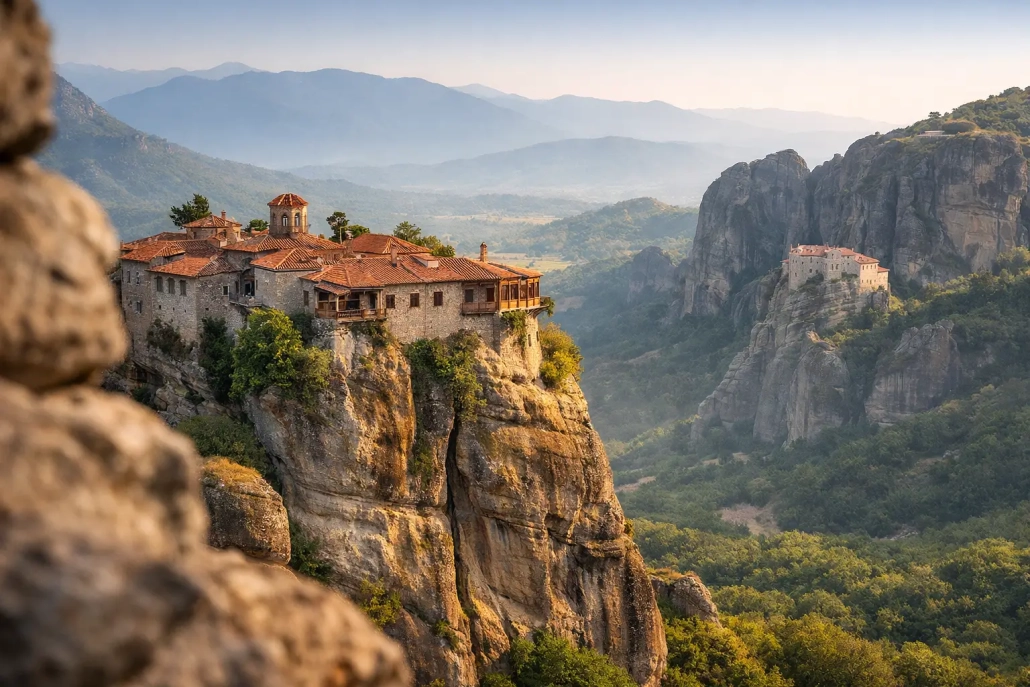
The first glimpse of Meteora can make even seasoned travelers fall quiet. Sandstone pillars rise straight from the Thessalian plain, crowned by monasteries that seem to hover between earth and sky. The finest Meteora monastery highlights are not simply the views, although they are extraordinary. They are the human stories of faith, endurance, art, and community that turned seemingly impossible cliffs into one of Greece’s most meaningful places to visit.
For travelers coming from Athens, Meteora deserves more than a rushed photo stop. A well-planned private journey gives you time to understand what you are seeing, enter the monasteries that suit your interests, and enjoy the landscape without the fixed pace of a large bus group.
Why Meteora Feels Unlike Any Other Greek Landmark
Meteora means “suspended in the air,” an apt name for a landscape shaped over millions of years by water and wind. Beginning in the 14th century, Orthodox monks sought solitude and security on these natural rock towers. Their first access routes involved ropes, ladders, and nets, with supplies hauled upward in baskets. The stone stairways visitors use today came much later.
At its height, Meteora had more than 20 active monasteries. Six remain open to visitors, each with a different personality, collection, setting, and practical level of access. Seeing every monastery in a single day is possible only at a hurried pace and is rarely the most rewarding approach. For most private travelers, two or three carefully selected visits, paired with scenic stops and time in Kalambaka or Kastraki, create a far richer experience.
Meteora Monastery Highlights to Prioritize
Great Meteoron: The Grand Historical Introduction
Great Meteoron is the largest and most historically significant monastery in Meteora. Founded in the 14th century by Saint Athanasios the Meteorite, it stands on the highest of the accessible rock formations and offers a powerful sense of scale before you even enter.
Inside, travelers find a museum with religious objects, manuscripts, monastic tools, and displays that explain daily life at Meteora. The katholikon, or main church, is richly decorated with post-Byzantine frescoes. Some scenes are emotionally intense, reflecting an era when faith and survival were closely intertwined.
This is often the best first monastery for visitors interested in history, architecture, and the wider story of the monastic community. It also involves a meaningful climb, so comfortable shoes and a realistic assessment of mobility are essential.
Varlaam: Frescoes, Relics, and Dramatic Views
Varlaam Monastery sits opposite Great Meteoron and is another essential stop for many first-time visitors. Its foundation is connected to the hermit Varlaam, while the monastery seen today was developed in the 16th century by two brothers, Theophanes and Nektarios Apsarades.
The church is especially admired for its frescoes, painted by the renowned Cretan artist Frangos Katelanos. Look beyond the artistry alone: these images were designed to teach, inspire, and preserve religious identity during a difficult period of Greek history.
Varlaam also offers excellent views toward the surrounding cliffs and valleys. It is a strong choice for couples and photographers, though, like Great Meteoron, it requires climbing stairs. The ascent is part of the experience, but it may not be ideal for every traveler.
Roussanou: A More Intimate Experience
Roussanou Monastery, dedicated to Saint Barbara, feels more compact and personal than the larger monasteries. Perched on a narrow rock, it is reached by bridges and steps that add to its visual drama. Today it is maintained by a community of nuns, and its gardens and carefully kept spaces often leave a lasting impression.
Its smaller scale makes Roussanou especially appealing to visitors who prefer an intimate atmosphere rather than a large museum-style visit. The views from its terraces are spectacular, revealing just how close the monasteries sit to the edge of the rock formations.
Because the paths can be narrow and the steps are unavoidable, timing matters. Visiting with a private driver who can adjust the order of stops can help avoid the busiest periods and make the day feel calmer.
Holy Trinity: The Iconic Cliffside Setting
Holy Trinity Monastery is one of the most photographed sites in Meteora. It rises from an isolated pinnacle and rewards visitors with a striking approach, dramatic panoramas, and a deep sense of remoteness. Its appearance in the James Bond film For Your Eyes Only introduced the monastery to a global audience, but its real significance reaches far beyond the screen.
The monastery is smaller and quieter than Great Meteoron or Varlaam. Reaching it requires a descent and ascent along a stairway carved into the rock, so it is best for travelers comfortable with a more demanding walk. If the physical effort is not right for your group, the exterior viewpoints still provide some of Meteora’s most memorable photographs.
Saint Stephen: The Most Accessible Monastery
Saint Stephen Monastery is often the best choice for travelers with limited mobility, families with younger children, or anyone who wishes to avoid a long climb. Rather than a steep staircase, visitors cross a short bridge from the road to reach the entrance.
Home to a community of nuns, Saint Stephen has a serene atmosphere, beautiful chapels, and broad views over the plain toward Kalambaka. Its position makes it particularly lovely later in the day, when the changing light softens the cliffs and the valley below.
Accessibility at Meteora is always relative, as historic buildings may include uneven surfaces and steps inside. Still, Saint Stephen offers the gentlest introduction to a working monastery and should be high on the list for many private groups.
Saint Nicholas Anapausas: Small but Artistically Important
Saint Nicholas Anapausas is the smallest of the six active monasteries, yet it contains one of Meteora’s great artistic treasures. The frescoes were painted by Theophanes the Cretan, an influential 16th-century iconographer whose work is admired for its expressive faces, color, and spiritual force.
The monastery’s narrow rock base shaped its unusual vertical layout, with rooms rising one above another. A visit here is brief but rewarding, particularly for travelers with a strong interest in Byzantine art. Its compact setting also demonstrates the remarkable ingenuity required to build a monastery where there was barely enough flat ground to stand.
Dress, Timing, and Respectful Visiting
Meteora remains an active religious site, not an open-air museum. Appropriate clothing is required: men should wear long pants, while women should wear skirts below the knee and have their shoulders covered. Some monasteries provide wrap skirts at the entrance, but bringing your own suitable clothing is the more comfortable and respectful choice.
Opening days and hours vary by monastery and season, and each community has its own closure schedule. This is one reason a fixed, one-size-fits-all itinerary can disappoint. A flexible private plan can prioritize the monasteries open on your travel date, rather than arriving at a closed gate after a long drive.
Photography rules also differ. Exterior photography is generally one of Meteora’s great pleasures, but interiors may restrict photos, video, or flash. Follow posted guidance and allow quiet moments in the churches. The most memorable visits often happen when travelers slow down long enough to notice the scent of incense, the candlelight, and the silence behind the stone walls.
Planning the Right Meteora Experience from Athens
Meteora is a long day trip from Athens, with driving time typically around four and a half hours each way depending on traffic and route conditions. It can be done in one ambitious day, especially for travelers with limited time and a private Mercedes vehicle for comfort. However, an overnight stay near Kalambaka or Kastraki gives you more breathing room, better light for photographs, and a chance to experience Meteora before or after the busiest daytime hours.
For cruise guests or visitors fitting Meteora into a wider mainland Greece itinerary, it may be more sensible to combine it with Delphi, Thermopylae, or another destination over multiple days. The right choice depends on your available time, mobility, and whether you want a scenic overview or a deeper cultural visit.
A knowledgeable local driver can handle the mountain roads, parking considerations, and changing monastery schedules, while a licensed guide adds historical and religious context inside the sites. Timeless Athens Tours can tailor that balance around your group, whether your priority is sacred art, panoramic viewpoints, comfortable transportation, or a thoughtfully paced family day.
Meteora rewards travelers who leave room for wonder. Choose fewer monasteries if necessary, pause at the overlooks, and let the scale of the cliffs remind you why these communities chose a place so far above ordinary life.


Leave a Reply
Want to join the discussion?Feel free to contribute!