
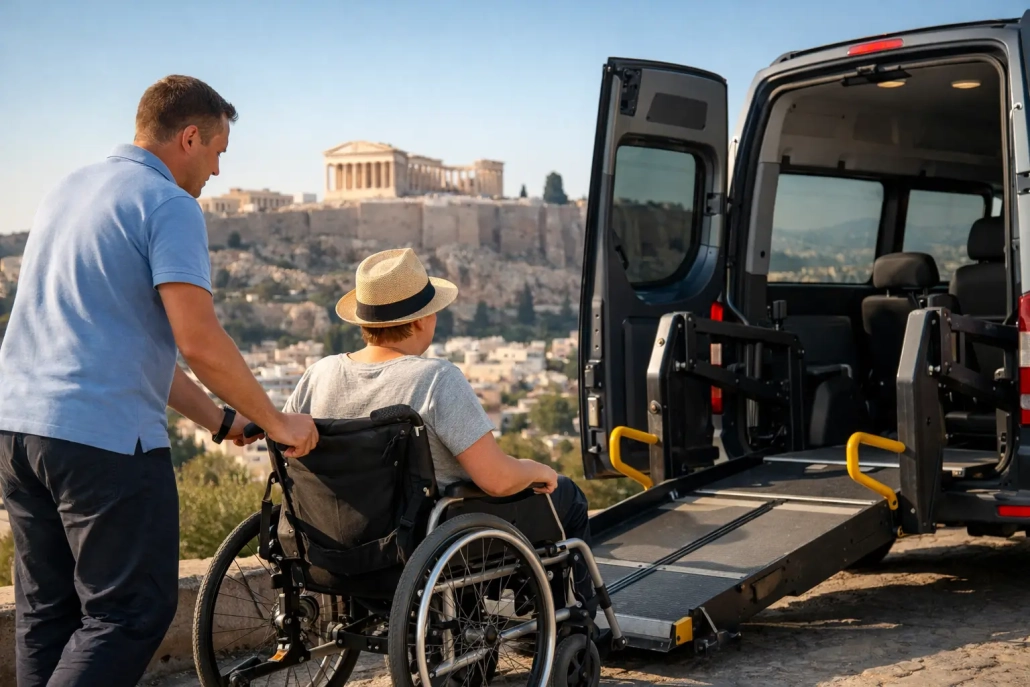
Wheelchair Transfers for Accessible Athens Travel
A delayed flight, a crowded cruise terminal, and Athens streets that rise and fall around ancient neighborhoods can turn a simple ride into the most stressful part of a trip. Thoughtful wheelchair transfers change that. They give travelers and families a clear plan from arrival to hotel, from sightseeing to departure, without leaving mobility needs to chance.
For a private Greece itinerary, transportation should support the experience rather than limit it. The right arrangements make room for the Acropolis, the Acropolis Museum, a long lunch in Plaka, or a day trip beyond Athens at a pace that feels comfortable and personal.
What wheelchair transfers should mean for your trip
The phrase can describe two different needs, and clarifying which one applies is the first step. Some travelers can move from a wheelchair into a standard vehicle seat with assistance, while the wheelchair is folded and carried separately. Others need to remain in their wheelchair during the ride, requiring a properly equipped accessible vehicle with a ramp or lift and secure tie-down points.
These are not interchangeable services. A spacious Mercedes van may be comfortable for many guests, but it is not automatically suitable for a passenger who must travel seated in a wheelchair. Confirm the vehicle configuration before booking, rather than relying on general descriptions such as “accessible” or “mobility friendly.”
A useful request includes the wheelchair’s type, width, length, height, weight, whether it folds, and whether it is manual or powered. Battery type matters for some electric chairs, especially when traveling by air. It also helps to explain whether the guest can step into a vehicle, use a transfer board, or needs a lift. Clear information allows a transportation provider to confirm what is genuinely possible and safe.
Plan the arrival before you land
Athens International Airport is outside the city center, so arrival day deserves more than a last-minute taxi plan. After a long international flight, standing curbside while searching for an appropriate vehicle is not the welcome most travelers want.
Arrange the pickup in advance and provide your flight number, expected arrival time, passenger count, luggage estimate, and mobility details. Ask where the driver will meet you, how long the route to your hotel usually takes, and what happens if the flight is delayed. A professional private transfer should include a clear meeting process and allow reasonable flexibility around real-world flight changes.
There is also a practical trade-off between vehicle space and group size. A wheelchair, several large suitcases, and four or five travelers can quickly fill a van. If comfort is the priority, a second vehicle may be a better choice than trying to fit everyone and everything into one tight cabin. Fixed, transparent pricing is especially valuable here because it avoids uncomfortable decisions at the airport.
Cruise passengers at Piraeus Port
For guests arriving by cruise ship, timing is even more important. Piraeus is a working port with several terminals, heavy traffic on busy call days, and ship schedules that do not always align neatly with local conditions. Share the ship name, terminal if known, docking and all-aboard times, and the exact plan for the day.
A private shore excursion can be tailored around the amount of time available and the traveler’s mobility. That may mean focusing on accessible highlights, enjoying scenic viewpoints, visiting the Acropolis Museum, and allowing time for a relaxed meal rather than attempting an overly ambitious checklist. The goal is not to rush through Athens. It is to experience its history and atmosphere with confidence that the return to the ship has been planned carefully.
Accessible touring in Athens requires realistic routing
Athens is extraordinary, but it is also an ancient city with uneven pavement, narrow lanes, steep grades, and occasional crowds. Accessibility varies by site, entrance, weather, and maintenance conditions. A good itinerary acknowledges that reality while still creating a rich day.
The Acropolis has accessibility provisions, including an elevator route for eligible visitors, but availability and operating conditions can change. Advance coordination is wise, and travelers should be prepared for security procedures, waiting periods, and terrain around the site. The Acropolis Museum is generally far easier to navigate and offers a rewarding way to understand the Parthenon sculptures, daily life, and the wider story of ancient Athens.
Private transportation helps because the route can adapt. If a street is congested or an entrance proves difficult, your driver can adjust the drop-off point, alter the order of stops, or give the group more time where it is most comfortable. This kind of flexibility is one of the strongest reasons to choose a private service over a large coach tour with a fixed schedule.
For travelers who prefer less walking, a panoramic Athens tour can still be memorable. See the changing guard at Syntagma Square, pass the Panathenaic Stadium, view the Temple of Olympian Zeus, and take in Lycabettus Hill or the Athens Riviera, depending on access and timing. History does not only live at the end of a staircase. A knowledgeable local driver or licensed guide can bring the city to life throughout the journey.
Questions to ask before confirming wheelchair transfers
The most reliable way to avoid disappointment is to ask direct questions and request direct answers. You do not need to know every technical detail, but a transportation provider should.
Ask whether the passenger can remain in the wheelchair during travel, whether the vehicle has a ramp or lift, and whether it includes approved wheelchair restraints and a passenger safety belt. Confirm the maximum wheelchair dimensions and weight, particularly for powered chairs and scooters. Ask if a companion may ride alongside the traveler and how luggage will be handled.
Also discuss assistance honestly. Drivers may be able to provide reasonable boarding support, but they are not necessarily trained caregivers or medical staff. If a traveler needs hands-on personal assistance, transfers, or support throughout the day, bringing a family member, companion, or qualified aide is usually the safest arrangement.
Finally, ask for the itinerary to be reviewed as a whole. A vehicle may be suitable, yet a particular restaurant, archaeological site, hotel entrance, or restroom may not be. A provider who takes time to assess these details is helping protect the quality of the entire trip, not merely selling a ride.
Comfort is part of the service
Accessible travel is not only about reaching a destination. It is about having enough time to board calmly, room to travel comfortably, and the assurance that a change of plan will not ruin the day.
Build in a little extra time between stops, especially in summer heat or during cruise-season crowds. Choose hotels with confirmed step-free access where possible, and let your driver know if you need a particular drop-off arrangement. For longer journeys to Delphi, Corinth, Nafplion, or other mainland destinations, schedule regular breaks and confirm accessible restroom options in advance.
At Timeless Athens Tours, private itineraries are built around the travelers in the vehicle, not a timetable designed for a busload of strangers. When mobility information is shared early, it becomes easier to shape a day with practical transport, meaningful sightseeing, and the personal care Greece is known for.
Athens rewards travelers who make room for its surprises: a sunlit view of the Parthenon, the scent of coffee from a neighborhood café, or a conversation that turns a historic monument into a human story. Plan the transport carefully, then leave space to enjoy those moments.


Leave a Reply
Want to join the discussion?Feel free to contribute!