
How to Explore Ancient Corinth in One Day
Ancient Corinth is where Greece’s great classical past meets the Roman world, early Christianity, and one of the country’s most dramatic engineering landmarks. For travelers wondering how to explore ancient Corinth, the answer is not to rush through the archaeological site alone. The experience becomes far more meaningful when you connect the Corinth Canal, the ancient marketplace, Acrocorinth, and the stories of St. Paul into one well-paced day from Athens.
Only about an hour from Athens, Corinth is an ideal private day trip for couples, families, cruise guests, and small groups who want major history without a long transfer. It is also a destination where a flexible itinerary matters. The ancient city is rich in details that can easily be missed without local context.
Start at the Corinth Canal
The Corinth Canal is not ancient, but it is the perfect first stop because it explains why Corinth mattered for thousands of years. The narrow waterway cuts through the Isthmus of Corinth, separating mainland Greece from the Peloponnese. From the bridge, the steep limestone walls and passing vessels offer a memorable introduction to the region.
Long before the canal opened in the late 19th century, rulers and merchants understood the value of this narrow strip of land. Instead of sailing around the Peloponnese, ships and cargo could cross the isthmus overland. Ancient Corinth grew prosperous because it controlled this strategic passage between the Aegean and Ionian seas.
A short stop is usually enough, but it sets the scene beautifully. Arriving early also means better light for photographs and fewer crowds at the viewing point.
How to Explore Ancient Corinth at the Archaeological Site
The Ancient Corinth Archaeological Site is the center of the visit. This was not a quiet provincial town. It was one of the Mediterranean’s busiest and wealthiest cities, first under the Greeks and later as a powerful Roman colony. Traders, sailors, officials, philosophers, athletes, and pilgrims passed through its streets.
Give the site at least 90 minutes, and closer to two hours if you enjoy archaeology or are traveling with a licensed guide. The ruins can look like a collection of foundations at first glance, but the story changes when you understand what stood here: markets, temples, civic buildings, fountains, shops, and gathering places.
See the Temple of Apollo
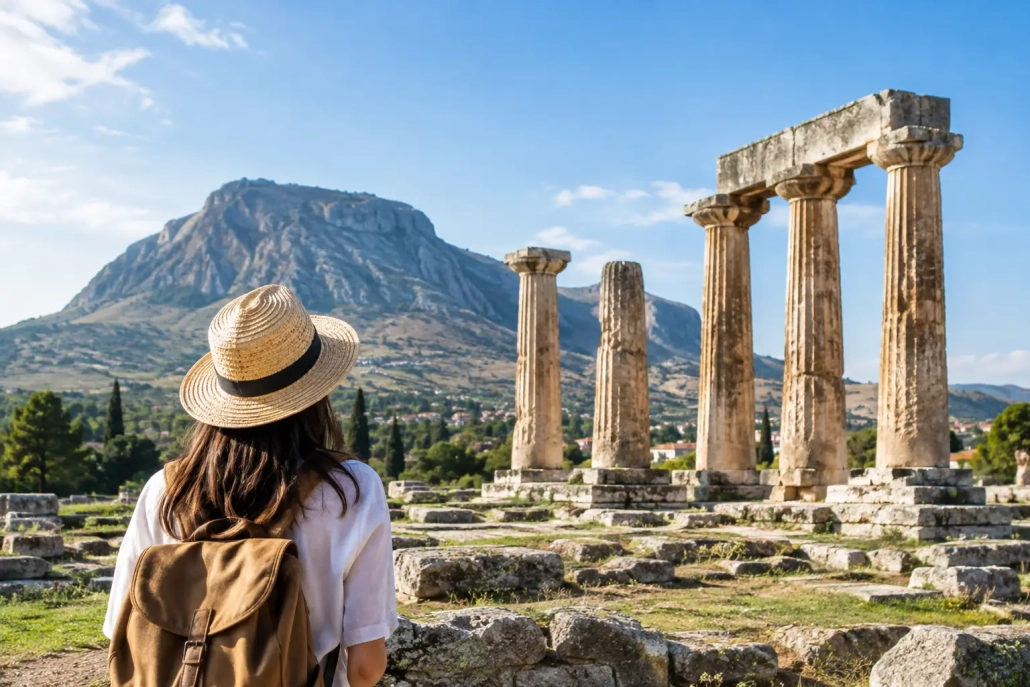
The Temple of Apollo is one of the site’s most recognizable landmarks. Its sturdy Doric columns date to the 6th century BC, making it one of the oldest surviving temples in mainland Greece. It stands above the agora, a reminder that Corinth was already a leading Greek city centuries before Rome took control.
Its scale may feel modest compared with the Parthenon, but that is part of its appeal. You can stand close enough to appreciate the weight of the stone and imagine the temple overlooking a crowded commercial center. This is a place where ancient religion and daily business existed side by side.
Walk Through the Roman Agora
The agora, or public marketplace, was Corinth’s social and commercial heart. After the Romans refounded the city in 44 BC, they transformed the area with monumental buildings, colonnades, shops, and administrative spaces. The remains reveal a city designed to impress visitors arriving from across the empire.
Look for the Bema, a raised platform associated with civic judgment. Christian tradition connects this spot with St. Paul, who was brought before the Roman proconsul Gallio during his stay in Corinth. Whether you are interested in biblical history, Roman law, or the everyday life of an ancient city, this is one of the most compelling places on the site.
Pause at the Fountain of Peirene
Water was essential to Corinth’s success, and the Fountain of Peirene was one of its most important sources. The visible remains are largely Roman, though the spring was known much earlier and was tied to Greek mythology. According to legend, the fountain was created from the tears of the nymph Peirene after the death of her son.
A guide can help distinguish myth from archaeology while showing how the fountain’s chambers, basins, and channels served a busy urban population. It is a small stop with a surprisingly human story behind it.
Visit the Archaeological Museum
Do not skip the museum, especially during hot weather. Its collections give the scattered stones outside a voice through pottery, mosaics, sculpture, inscriptions, and everyday objects. The Roman mosaic floors are particularly impressive, while inscriptions help illuminate the city’s administration, religion, and multicultural population.
The museum also helps visitors understand the long timeline of Corinth. This was not simply a Greek city that later became Roman. It continuously adapted to changing rulers, trade routes, faiths, and cultural influences.
Add Acrocorinth for the Best Perspective
Rising above the archaeological site, Acrocorinth is the great fortified hill that guarded the city. It is one of the largest and most impressive castles in Greece, with defenses expanded by the Greeks, Romans, Byzantines, Franks, Venetians, and Ottomans.
The climb is worthwhile for travelers who are comfortable walking on uneven ground and moderate inclines. At the top, the views stretch across the ancient city, the Gulf of Corinth, and the surrounding mountains. More than a scenic bonus, the fortress explains Corinth’s military importance. Whoever controlled this hill controlled a key route into the Peloponnese.
There is a trade-off. Acrocorinth can make the day feel more active, particularly in summer heat or if young children and guests with limited mobility are in the group. A private itinerary lets you decide whether to prioritize the fortress, spend longer in the museum, or enjoy a relaxed lunch instead.
Understand St. Paul’s Corinth
For many American visitors, Corinth has special meaning because of its connection to the Apostle Paul and the New Testament letters known as First and Second Corinthians. Paul lived and worked in Corinth for approximately 18 months during the first century AD, when the city was a thriving Roman commercial center.
This context matters. Paul was not writing to a remote village. He was addressing a diverse, ambitious, sometimes divided urban community shaped by wealth, trade, pagan worship, and Roman authority. Walking through the agora makes the setting of those letters feel immediate.
A biblical-focused visit can include the Bema and the archaeological site, with time for thoughtful explanation rather than treating the location as a quick photo stop. Travelers with a wider historical interest can place Paul’s story alongside the Greek and Roman layers of the city.
Plan the Drive From Athens Wisely
Ancient Corinth is approximately 50 miles west of Athens, making it a comfortable day trip by private vehicle. The route follows the national highway toward the Peloponnese, and the drive is generally around one hour each way, depending on traffic and pickup location.
For visitors staying in central Athens, a morning departure allows time for the Corinth Canal, Ancient Corinth, Acrocorinth, and a lunch stop in the modern village or nearby coastal area. Cruise passengers arriving at Piraeus should allow extra time for port traffic and the return journey, especially if their ship has a strict all-aboard time.
A private Mercedes vehicle is particularly useful here. You avoid train schedules, multiple transfers, and the challenge of reaching Acrocorinth after visiting the lower archaeological site. Your driver can adjust the order of stops according to weather, opening hours, mobility needs, and your preferred pace.
What to Wear and Bring
Corinth rewards practical preparation. Wear supportive walking shoes with good grip, as the archaeological paths and Acrocorinth surfaces can be uneven. In warmer months, bring water, sun protection, and a hat. The open agora has limited shade, and midday temperatures can be intense.
It is also wise to carry a light layer in spring or fall, particularly if you plan to visit the fortress. Weather can feel cooler and windier at the higher elevation. Site hours and access conditions may change seasonally, so confirm the current schedule before your visit.
Make the Day Personal
The best Corinth itinerary depends on what you want from Greece. History enthusiasts may want extended time at the museum and Acrocorinth. Families may prefer the canal, the main archaeological site, and a relaxed lunch. Faith-based travelers may wish to focus on St. Paul’s connection to the Roman city. A knowledgeable local driver and licensed guide can shape the day around those interests without sacrificing comfort or timing.
Timeless Athens Tours can arrange a private Corinth experience with premium transportation, fixed transparent pricing, and the flexibility to add nearby destinations such as Mycenae, Epidaurus, or Nafplion when your schedule allows. Travel with the Best, don’t Guess!
When you stand in Corinth’s agora, take a moment before moving to the next landmark. The broken columns, temple, fountain, and distant fortress are not separate attractions. Together, they tell the story of a city that spent centuries at the crossroads of trade, power, faith, and human ambition.

Leave a Reply
Want to join the discussion?Feel free to contribute!