
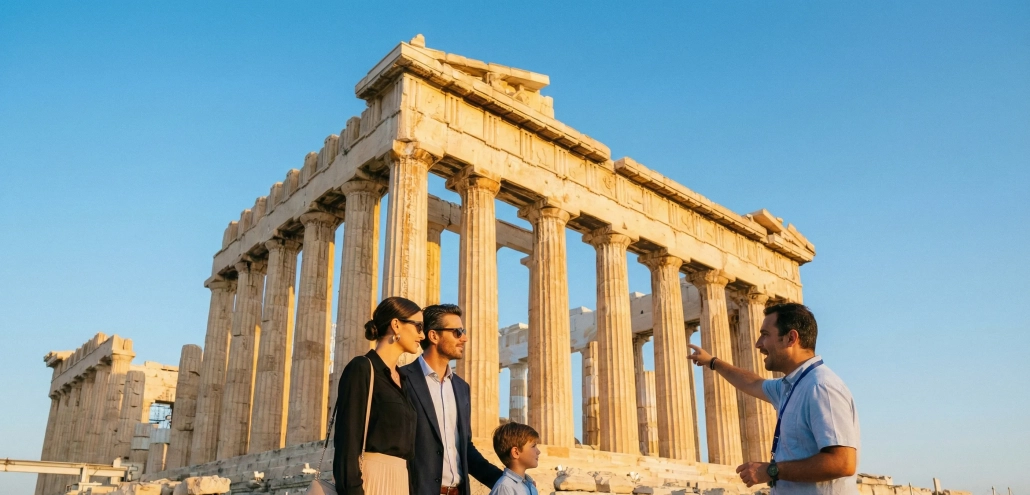
Private Tour Acropolis 2025: Complete Guide + Best Athens Ancient Sites Upgrades
Securing exclusive private tour access to the Acropolis transforms rushed mass tourism into intimate archaeological exploration, bypassing ticket queues stretching hours during peak season, receiving personalized interpretation from licensed experts rather than competing with fifty tourists for guide attention, and controlling your schedule rather than following rigid group timelines. The sacred rock rising 156 meters above Athens hosts the Parthenon, Erechtheion, Propylaea gateway, and Temple of Athena Nike, monuments that defined Western architecture and democratic ideals during the Golden Age of Pericles. While private tour Acropolis experiences provide exceptional value for focused UNESCO World Heritage exploration, most travelers discover that upgrading to comprehensive athens day tours visiting five to seven ancient sites, Ancient Agora where Socrates taught, Temple of Olympian Zeus surpassing Parthenon scale, Panathenaic Stadium hosting original Olympics, delivers substantially greater cultural depth across comparable timeframes while expert guides connect Athens’ classical monuments into coherent civilizational narratives impossible when experiencing sites individually.
What is private tour Acropolis? Private tour Acropolis provides exclusive small-group or individual access to Athens’ ancient citadel with licensed archaeological experts, featuring skip-the-line entry, flexible timing, and personalized interpretation of Parthenon, Erechtheion, Propylaea, and Temple of Athena Nike across two to three hours, though comprehensive ancient Athens tours visiting additional UNESCO sites like Ancient Agora, Temple of Zeus, and Panathenaic Stadium offer superior value through extended archaeological context at the birthplace of democracy.
What is Private Tour Acropolis?
Private tour Acropolis represents personalized archaeological exploration of Athens’ most iconic ancient monument, delivered through licensed expert guides providing exclusive attention to individuals, families, or small groups typically limited to six to eight participants maximum. Unlike mass tourism where fifty-plus tourists strain to hear guides through crowded conditions, private experiences ensure every question receives thorough answers, every architectural detail gets examined at your preferred pace, and photography opportunities occur without competing for positions among crowds. The standard private format includes hotel pickup, skip-the-line tickets bypassing entrance queues that extend ninety minutes during summer peak season, and flexible departure timing accommodating your schedule rather than fixed group tour requirements.
The experience centers on exploring the Acropolis archaeological site atop the rocky outcrop dominating central Athens, where monuments constructed during the fifth century BCE under statesman Pericles’ ambitious building program represent classical Greek civilization’s architectural zenith. Your licensed guide, typically holding archaeology or history degrees with specialized Acropolis knowledge, interprets the Parthenon’s Doric columns carved from Pentelic marble, explains the Erechtheion’s Porch of Maidens featuring six Caryatides supporting the roof structure, walks you through the monumental Propylaea gateway separating sacred from profane spaces, and details the Temple of Athena Nike commemorating victories over Persian invaders. The intimate format allows diving deep into topics matching your interests: architectural refinements creating optical illusions of perfect symmetry, mythological narratives depicted in surviving sculptural friezes, or political context surrounding democratic Athens’ transformation into Mediterranean superpower.
However, private Acropolis tours typically consume only two to three hours, comprehensive for the hilltop sanctuary itself but representing merely one component of ancient Athens’ rich archaeological landscape. Most first-time visitors initially focus exclusively on the Acropolis due to its UNESCO World Heritage fame and Parthenon’s iconic global recognition, only discovering afterward that equally significant ancient sites like the Ancient Agora where democracy was practiced, Temple of Olympian Zeus rivaling Roman engineering, and Panathenaic Stadium preserving original Olympic competition venues sit within walking distance offering complementary historical narratives. This realization leads many travelers to wish they’d booked comprehensive athens walking tours combining multiple ancient sites into cohesive full-day experiences maximizing both time efficiency and archaeological understanding through expert-guided connections between Athens’ classical monuments.
Private Acropolis Tour Options: Duration and Coverage
Private tour formats for Acropolis exploration range from focused two-hour hilltop-only experiences to comprehensive eight-hour ancient Athens immersions visiting seven major archaeological sites, with smart travelers recognizing that extended options deliver exponentially greater value per hour invested through contextual connections impossible when viewing monuments in isolation.
Option 1: Acropolis-Only Private Tour (2-3 Hours)
The focused approach concentrates exclusively on the Acropolis archaeological site itself, ascending from the southwest entrance past the Theatre of Dionysus where ancient Greek drama was born, climbing the marble pathways to the summit plateau, exploring Parthenon exterior details (interior access restricted for preservation), examining the Erechtheion’s sacred olive tree marks and Poseidon’s trident scars from mythological contests, passing through the Propylaea’s massive gateway columns, and visiting the compact Temple of Athena Nike jutting from the southern bastion. The experience concludes with panoramic photography from viewpoints overlooking modern Athens, Saronic Gulf waters, and surrounding mountains. This format works excellently for travelers with limited Athens time who prioritize the single most famous ancient site, cruise passengers with brief port calls, or return visitors who’ve previously explored other archaeological zones and want focused Acropolis expertise.
However, completing Acropolis exploration by late morning or early afternoon leaves the remainder of your day unstructured, and the isolated hilltop visit provides no context for how Acropolis monuments related to daily ancient Athenian life in the city below, the agora marketplaces where citizens debated democracy, the temples honoring various deities beyond Athena, or the athletic facilities where Olympic traditions originated.
Option 2: Ancient Athens Private Tour (5-6 Hours) – RECOMMENDED
The comprehensive approach combines Acropolis exploration with four to five additional major archaeological sites, creating cohesive narrative arcs explaining how classical Athens functioned as integrated civilization rather than disconnected monuments. Beyond the Acropolis itself, athens tours visit the Ancient Agora, the marketplace and political center where Socrates, Plato, and Aristotle philosophized, democratic assemblies voted on laws, and commercial life thrived beneath the reconstructed Stoa of Attalos now housing archaeological museum displays. The Temple of Olympian Zeus showcases Rome’s later contributions to Athens through colossal Corinthian columns exceeding Parthenon scale, while the Panathenaic Stadium preserves white marble seating for 50,000 spectators at the 1896 inaugural modern Olympics, built atop the ancient stadium hosting Panathenaic Games honoring Athena.
Additional stops typically include Hadrian’s Arch marking the boundary between classical Greek and Roman Athens, the Roman Agora with its octagonal Tower of the Winds functioning as ancient sundial and weather station, and Plaka neighborhood walks through Byzantine church-lined streets where Ottoman and modern Greek layers overlay ancient foundations. Authentic taverna lunches provide cultural immersion beyond archaeology, with guides recommending family-owned establishments serving traditional recipes rather than tourist-trap chains. This format delivers the optimal balance between comprehensive coverage and manageable pacing, dedicating five to six hours to substantive archaeological education while avoiding the exhaustion that eight-hour marathons sometimes create.
Option 3: Full-Day Athens Exploration (7-8 Hours)
The extended immersion adds Acropolis Museum visits showcasing original sculptures removed from monuments for preservation, with the museum’s glass floor revealing ongoing excavations of ancient Athenian neighborhoods beneath the modern structure. Additional time allows leisurely exploration of Kerameikos ancient cemetery where elaborate marble tombstones commemorate Athenian aristocrats, or the Lyceum where Aristotle founded his philosophical school. Some private athens tour options incorporate modern Athens landmarks like Constitution Square’s Evzone guard changes, National Archaeological Museum treasures, or Monastiraki flea market shopping alongside ancient sites. This format suits archaeology enthusiasts wanting maximum depth, families with teenagers whose attention spans handle extended educational experiences, or travelers making Athens their primary Greek destination rather than quick stopover between islands.
Complete Athens Ancient Sites Comparison
| Tour Option | Duration | Archaeological Sites | UNESCO Sites | Expert Depth | Best For | Athens Tours Availability |
| Acropolis Only | 2-3 hours | 1 major site | 1 (Acropolis) | Focused hilltop | Limited time visitors | ✅ Available |
| Ancient Athens | 5-6 hours | 5-7 major sites | 2 (Acropolis + Agora) | Comprehensive | Most travelers | ✅ Recommended |
| Full-Day Athens | 7-8 hours | 7-9+ sites | 2-3 depending on route | Maximum immersion | Archaeology enthusiasts | ✅ Available |
| Quick Overview | 3-4 hours | 2-3 sites | 1 | Surface level | Very limited time | ✅ Available |
Winner: Ancient Athens tour (5-6 hours) delivers optimal value through comprehensive coverage without exhaustion, visiting sufficient sites for civilizational context while maintaining engagement through varied pacing.
What’s Included in Private Tour Acropolis?
Standard private Acropolis tour packages bundle essential elements ensuring seamless experiences without unexpected additional costs or logistical confusion that sometimes plague independent archaeological site visits. Skip-the-line admission tickets to the Acropolis archaeological zone come included, bypassing entrance queues that extend sixty to ninety minutes during summer peak season when thousands of daily visitors converge on Athens’ most famous monument. The skip-the-line benefit alone justifies booking guided experiences rather than purchasing tickets independently, as the time saved waiting in Mediterranean sun gets redirected toward actual archaeological exploration.
Licensed archaeological experts or historians serve as your guides, holding official certifications from Greek tourism authorities confirming specialized knowledge and professional training in monument interpretation. These aren’t casual tour operators reading memorized scripts, they’re typically archaeology graduates, museum professionals, or academic researchers who’ve dedicated careers to ancient Greek civilization studies and deliver insights impossible through audio guide recordings or guidebook reading. The personalized attention means asking unlimited questions, requesting deeper explanations of topics matching your interests, and receiving recommendations for additional Athens experiences beyond the tour itself.
Hotel pickup and drop-off from centrally located Athens accommodations eliminates navigation confusion in unfamiliar city streets, with professional drivers handling morning logistics while you relax. Flexible departure timing accommodates your schedule preferences, want to start at 8:00am beating crowds for optimal photography in soft morning light? Tour operators adjust. Prefer 10:00am after leisurely hotel breakfast? They accommodate. This flexibility contrasts sharply with mass group tours departing at fixed times regardless of individual preferences. Small group sizes ranging from two to eight participants maximum (or completely private for solo travelers or families wanting exclusive attention) ensure intimate experiences where every participant hears guide commentary clearly, asks questions without competing for attention, and moves at comfortable pacing rather than being rushed by the slowest or fastest group members.
For comprehensive athens city tour packages extending beyond Acropolis-only formats, additional inclusions typically cover entrance tickets to supplementary archaeological sites visited during the extended experience, traditional taverna lunches featuring Greek cuisine specialties like moussaka, grilled octopus, or stuffed vine leaves, and comfortable air-conditioned transportation between dispersed monuments across Athens’ sprawling metropolitan area. Some premium options incorporate Acropolis Museum admission for viewing original sculptures and friezes removed from Parthenon and other temples for preservation, though basic packages may list museum entry as optional upgrade depending on time allocation and group interests.
Why Upgrade to Full Ancient Athens Tour? The Value Case
While focused Acropolis visits satisfy initial monument-viewing desires, the isolated hilltop exploration provides incomplete understanding of how ancient Athens functioned as integrated civilization where religious sanctuaries, democratic institutions, commercial marketplaces, athletic competitions, and philosophical schools interconnected through daily life patterns spanning the classical and Hellenistic periods. Upgrading to comprehensive ancient Athens experiences delivers substantially greater educational value through contextual connections that transform disconnected monument visits into coherent narratives explaining Western civilization’s foundational city.
Archaeological Context: Democracy’s Birthplace
The Ancient Agora situated northwest of the Acropolis served as ancient Athens’ political, commercial, and social heart where democratic governance evolved from theoretical ideals into practical reality. Here, citizen assemblies gathered to debate laws and vote on policies affecting Mediterranean’s most powerful city-state, while philosophers like Socrates questioned conventional wisdom through dialogues preserved in Plato’s written accounts, and commercial vendors sold goods in covered colonnades surrounding the open square. The reconstructed Stoa of Attalos, a two-story covered walkway originally built by Pergamene king Attalos II as gift to Athens, now houses an archaeological museum displaying artifacts excavating from the agora area: pottery fragments bearing ancient price lists, bronze voting tokens used in democratic procedures, and ostraka (pottery shards) inscribed with politicians’ names for ostracism votes banishing unpopular leaders from the city.
Walking the Ancient Agora paths where Socrates conversed with students, where democratic institutions like jury courts and council chambers operated, and where commercial life thrived provides essential context for understanding why Athenians invested enormous resources constructing Acropolis monumentsm, the hilltop sanctuary represented religious and civic pride for the democratic city flourishing below. Comprehensive athens guided tours connecting both sites explain how Panathenaic Festival processions began in the Agora, processed through city streets depicted on the Parthenon’s famous frieze, and climaxed with ceremonial robe presentations to Athena’s statue inside the Parthenon, rituals integrating religious devotion with civic identity impossible to fully appreciate when viewing Acropolis in isolation.
Architectural Scale: Beyond Parthenon Dominance
The Temple of Olympian Zeus demonstrates that Parthenon’s fame derives from aesthetic perfection and cultural significance rather than mere size, as the Zeus temple’s surviving Corinthian columns tower seventeen meters high, several meters taller than Parthenon’s Doric columns, with original layouts encompassing 104 columns (only fifteen survive standing) across a footprint exceeding the Parthenon’s dimensions. Construction began in the sixth century BCE under tyrant Peisistratos but wasn’t completed until Roman emperor Hadrian’s second-century CE reign, symbolizing how Athens’ importance extended centuries beyond the classical Golden Age. The temple showcases Corinthian order’s ornate capitals featuring acanthus leaf decorations, contrasting with the Parthenon’s simpler Doric style and the Erechtheion’s Ionic elements, allowing visitors to compare three major architectural orders side-by-side within a single city.
The Panathenaic Stadium reconstructed in white Pentelic marble for the 1896 inaugural modern Olympics preserves the ancient stadium’s horseshoe layout where Panathenaic Games athletic competitions honored Athena every four years, with 50,000 spectators filling marble benches to watch foot races, discus throwing, and other events predating the more famous Olympia games. Standing on the ancient starting line where competitors launched sprints 2,500 years ago creates visceral connections to Olympic traditions’ origins impossible through distant viewing from Acropolis heights, while guides explain how Panathenaic victors received olive oil amphorae decorated with Athena images, prestigious prizes that archaeological museums now showcase as artistic masterpieces.
Extended Time Investment Delivers Exponential Returns
The mathematics of time efficiency favor comprehensive tours dramatically. Acropolis-only experiences consuming two to three hours deliver single-site focus but dedicate roughly one hour to logistics (hotel pickup, entrance procedures, return drop-off) for approximately two hours actual archaeological exploration. Ancient Athens tours consuming five to six hours allocate similar logistics time but extend archaeological exploration to four to five hours across five to seven major sites, doubling actual cultural content while logistics overhead increases minimally. When calculating educational value per total hour invested, comprehensive tours deliver exponentially greater returns: visitors gain four to five times more archaeological sites for only twice the time commitment, while expert guides connect disparate monuments into coherent narratives that isolated Acropolis visits cannot provide.
Archaeological Value: Extended Coverage Comparison
| Feature | Acropolis Only | Ancient Athens Tour | Added Value |
| Archaeological sites | 1 major complex | 5-7 major sites | +400-600% |
| UNESCO designations | 1 (Acropolis) | 2 (Acropolis + Agora) | +100% |
| Architectural orders | Doric, Ionic | Doric, Ionic, Corinthian | Complete set |
| Historical periods | Classical only | Classical + Roman + Byzantine | Comprehensive |
| Democracy context | Religious only | Religious + political + social | Full picture |
| Expert interpretation | Monument-focused | Civilization-focused | Deeper understanding |
| Photography variety | Single hilltop | Multiple perspectives | Diverse portfolio |
| Lunch included | No | Traditional taverna | Cultural immersion |
Winner: Ancient Athens tour provides 4-5x more archaeological coverage for 2x time investment, delivering exponentially better educational value through contextual connections.
This comparative advantage explains why experienced travelers and return visitors consistently recommend comprehensive ancient Athens experiences over focused Acropolis-only visits, recognizing that the additional time investment yields dramatically greater understanding of classical civilization’s birthplace while expert guides transform potentially overwhelming information overload into engaging narratives that novice and expert archaeology enthusiasts both appreciate. Those wanting maximum value from limited Athens time discover that athens half day tours covering three to four major sites represent the optimal sweet spot between focused monument visits and exhaustive full-day marathons.
Best Time for Private Tour Acropolis: Maximizing Your Experience
Strategic timing dramatically impacts Acropolis tour quality through crowd density variations, photography lighting conditions, and temperature comfort levels that shift across daily cycles and seasonal patterns. Understanding optimal visit windows allows maximizing enjoyment while minimizing the discomfort that poorly timed visits sometimes create.
Early morning departures between 8:00am and 9:00am deliver the best overall experience by arriving shortly after the archaeological site opens, when visitor numbers remain manageable and morning light creates ideal photography conditions illuminating Pentelic marble columns without the harsh shadows that midday Mediterranean sun produces. Summer temperatures stay tolerable before the brutal 35-40°C afternoon heat that transforms marble pathways into radiant ovens, while spring and autumn mornings offer perfect 18-22°C comfort for extended walking across uneven ancient terrain. Early timing also means your private guide’s energy and enthusiasm remain fresh rather than depleted after conducting multiple tours throughout the day, translating into more engaged interpretation and patient question-answering. Most importantly, securing early slots requires advance booking since demand for optimal times exceeds availability, particularly during peak summer season when tour operators receive far more morning requests than their licensed guide capacity accommodates.
Late afternoon visits between 4:00pm and 5:00pm represent the second-best option, offering the advantage of golden hour photography as setting sun bathes monuments in warm amber light creating dramatic shadows and colors impossible during midday hours when overhead sun flattens architectural details into washed-out uniformity. Afternoon crowds thin as tour groups complete their visits and depart for dinner, leaving the site relatively peaceful compared to the 10:00am-2:00pm peak congestion when thousands of tourists simultaneously explore the compact hilltop sanctuary. However, late timing comes with trade-offs: summer afternoons remain uncomfortably hot until 6:00pm or later, forcing visitors to endure heat exhaustion conditions, and winter’s early sunsets (around 5:30pm) compress available exploration time before the site closes at 6:00pm during December and January.
Midday visits between 10:00am and 2:00pm represent the least desirable timing despite many travelers defaulting to these hours through poor planning or accommodation by tour operators filling their schedules. Peak crowding creates congestion at popular photo spots where dozens of tourists simultaneously compete for identical Parthenon angles, guide commentary becomes difficult to hear over ambient noise from surrounding groups, and the overwhelming people density transforms intimate archaeological exploration into rushed herding through human traffic jams. Brutal Mediterranean sun creates harsh lighting conditions for photography while making unshaded marble pathways uncomfortably hot, and heat exhaustion risks increase substantially during summer months when temperatures regularly exceed 35°C without any tree cover providing relief on the exposed hilltop.
Seasonal considerations affect timing recommendations differently across calendar periods. Summer months (June through August) absolutely require early morning scheduling to avoid dangerous afternoon heat, while winter (December through February) offers flexibility since mild temperatures and reduced tourist numbers make midday visits perfectly comfortable. Spring (March through May) and autumn (September through November) represent ideal overall visit periods, combining comfortable temperatures, moderate crowds, and extended daylight allowing flexibility across morning and afternoon slots. However, even during optimal seasons, advance booking remains essential since private tours athens operators maintain limited daily capacity through licensed guide availability constraints and Acropolis site management regulations restricting simultaneous visitor numbers.
How to Book Private Tour Acropolis: Simple Process
Securing your private Acropolis tour requires advance planning since optimal time slots fill quickly, particularly during peak travel seasons when demand exceeds tour operator capacity. The booking process follows straightforward steps that most travelers complete within ten to fifteen minutes using online platforms or direct communication with tour operators.
Step 1: Select Your Tour Format – Decide between focused Acropolis-only experiences (2-3 hours), comprehensive ancient Athens tours visiting five to seven sites (5-6 hours), or extended full-day explorations (7-8 hours) based on your available time, archaeology interest depth, and physical stamina for extended walking. Review what each format includes regarding specific sites visited, meal provisions, museum admissions, and transportation coverage to ensure the package matches your expectations.
Step 2: Choose Your Preferred Date and Departure Time – Identify your ideal visit date and request early morning (8:00-9:00am) or late afternoon (4:00-5:00pm) time slots for best conditions. Provide alternative dates and times as backup options since popular slots book weeks in advance during high season. Consider coordinating your Acropolis tour early in your Athens stay so that insights gained from expert guides inform your subsequent independent explorations of additional archaeological sites, museums, or neighborhoods.
Step 3: Confirm Group Size and Special Requirements – Specify the number of participants joining your private tour, noting any children whose ages qualify for reduced admission rates, and communicate special requirements such as mobility limitations requiring accessible route planning, language preferences beyond English if booking multilingual guide services, or specific interest topics you’d like guides emphasizing during interpretation. Athens tour operators accommodate reasonable customization requests when provided advance notice, but last-minute special requirements cannot always be fulfilled if they require specific guide expertise or equipment arrangements.
Step 4: Provide Hotel Information for Pickup – Share your Athens accommodation name and address so tour operators arrange convenient morning pickup eliminating navigation confusion in unfamiliar city streets. Hotels in central neighborhoods like Plaka, Syntagma, Monastiraki, or Kolonaki qualify for included pickup, while accommodations in distant suburbs or airport hotels may require meeting at designated central locations or incur supplementary transfer fees. Confirm pickup time the evening before your tour through reminder communications tour operators typically send reviewing final logistics.
Step 5: Receive Confirmation and Prepare – After completing booking and payment processing, you’ll receive confirmation emails containing tour operator contact information, emergency phone numbers, cancellation policy details, and recommended preparation suggestions like wearing comfortable walking shoes for uneven terrain, bringing sun protection during summer months, and carrying water bottles for hydration. Many tour operators provide pre-tour reading materials or multimedia resources helping maximize your experience through background knowledge before arriving at the archaeological site. Review the confirmation carefully noting any items you need bringing like passport or identification documents required for site entry or photography equipment for capturing memories without violating archaeological preservation regulations prohibiting tripods or professional lighting equipment.
Begin your ancient Athens exploration today by booking comprehensive day tours combining Acropolis highlights with additional major archaeological sites, ensuring your limited vacation time delivers maximum cultural depth through expert-guided experiences connecting classical monuments into coherent civilization narratives that isolated visits cannot provide.
Frequently Asked Questions
Is private tour Acropolis worth the investment?
Absolutely, for travelers valuing expert interpretation and intimate experiences over mass tourism. Private Acropolis tours transform potentially confusing ancient monument viewing into educational archaeological exploration through licensed expert guides explaining architectural refinements, mythological narratives, and historical contexts that independent visitors miss when wandering sites without professional interpretation. The skip-the-line access alone justifies the investment by saving sixty to ninety minutes waiting in entrance queues during peak season, time that gets redirected toward actual site exploration rather than standing in Mediterranean sun. Flexible timing, personalized attention allowing unlimited questions, and small group sizes ensuring comfortable pacing create substantially superior experiences compared to fifty-person group tours where guides rush through predetermined scripts while participants strain to hear commentary.
However, smart travelers recognize that investing in comprehensive athens walking tours visiting five to seven major archaeological sites delivers exponentially better value than focused Acropolis-only experiences consuming similar time. The Ancient Agora where democracy was practiced, Temple of Olympian Zeus showcasing Roman architectural ambitions, and Panathenaic Stadium preserving Olympic traditions provide essential context for understanding why ancient Athenians invested enormous resources constructing Acropolis monuments, while expert guides connect disparate sites into coherent civilization narratives that isolated visits cannot replicate.
How long does private tour Acropolis take?
Standard Acropolis-focused tours consume two to three hours total from hotel pickup through site exploration and return drop-off, with approximately ninety minutes to two hours dedicated to actual archaeological walking and interpretation on the hilltop sanctuary itself. The remaining time covers transportation logistics between central Athens hotels and the Acropolis entrance, skip-the-line admission processing, initial orientation briefings from guides, and concluding question-answer sessions before departure. This duration proves sufficient for thoroughly examining the Parthenon’s architectural refinements, Erechtheion’s Porch of Maidens featuring six Caryatides, Propylaea monumental gateway, Temple of Athena Nike, and Theatre of Dionysus while expert guides explain construction techniques, mythological associations, and historical contexts at comfortable pacing without rushed herding.
However, completing Acropolis exploration by late morning or midday leaves extensive afternoon time unstructured, and the isolated monument viewing provides incomplete understanding of ancient Athens’ integrated civilization. Most visitors discover they’d have preferred comprehensive ancient Athens tours extending five to six hours and visiting seven archaeological sites, delivering four times the content for only double the time investment while maintaining engagement through varied pacing alternating between religious sanctuaries, democratic institutions, athletic facilities, and commercial marketplaces that collectively explain Western civilization’s foundational city.
What should I wear for private tour Acropolis?
Comfortable walking shoes with good traction represent the single most important clothing consideration since ancient marble pathways feature uneven surfaces, worn stone steps, and smooth areas that become slippery when wet or dusty. Athletic sneakers, hiking shoes, or cushioned walking sandals with secure ankle support work excellently, while fashion sandals, flip-flops, dress shoes, or high heels create dangerous conditions risking twisted ankles or falls on irregular terrain. The archaeological site involves substantial uphill walking from entrance gates to summit plateau followed by extensive standing and walking across the hilltop exploring various monuments, typically accumulating three to five kilometers total distance over uneven ground.
Clothing should balance sun protection needs against movement comfort, with lightweight breathable fabrics in light colors reflecting rather than absorbing Mediterranean solar radiation. Wide-brimmed hats and sunglasses protect against intense summer sun exposure on the completely unshaded hilltop, while sunscreen application becomes essential since reflective white marble amplifies UV radiation beyond direct sunlight alone. Athens day tours occur outdoors entirely, making weather-appropriate preparation crucial for enjoyment, summer requires maximum sun and heat protection, spring and autumn benefit from layering options accommodating variable temperatures, and winter may need light rain jackets during Greece’s mild precipitation season though serious storms rarely occur.
Can I visit Acropolis without guided tour?
Yes, independent visits are perfectly feasible through purchasing standard admission tickets at entrance gates or via online advance booking, then exploring the archaeological site using guidebooks, smartphone apps, or audio guide rentals providing self-directed interpretation. The compact hilltop layout prevents getting seriously lost, and directional signage in Greek and English marks major monuments, making unguided exploration accessible for travelers preferring self-paced investigation over structured tour formats. Independent visiting offers maximum flexibility in timing and pacing, allows lingering at personally interesting features without group schedules constraining attention, and eliminates guided tour costs for budget-conscious travelers.
However, the unguided approach means missing expert interpretation explaining architectural subtleties invisible to untrained eyes, mythological narratives providing cultural context for sculptural decorations, and historical connections between Acropolis monuments and ancient Athenian civilization’s democratic institutions, philosophical schools, and commercial activities centered in the city below. Most first-time visitors exploring independently later regret not booking expert-guided experiences after realizing how much information they missed through relying on brief guidebook descriptions or audio commentary covering only basic facts. The Acropolis represents one of world history’s most significant archaeological sites where professional interpretation transforms stone ruins into meaningful civilization narratives, making expert guidance worthwhile even for travelers who typically prefer independent sightseeing.
Is Acropolis Museum included in tour?
Acropolis Museum inclusion varies by tour package depending on format duration and operator pricing structures. Focused two to three-hour Acropolis-only tours typically exclude museum visits since covering both the outdoor archaeological site and the extensive museum collection comprehensively requires five to six hours minimum, exceeding brief tour formats. Some operators offer museum visits as optional upgrades adding ninety minutes to two hours and supplementary admission fees, while others present museum exploration as entirely separate tour experience bookable independently. Comprehensive ancient Athens packages extending five to eight hours generally include museum visits as integrated components, allowing viewing original sculptures, friezes, and Caryatides removed from Parthenon and Erechtheion for preservation after centuries of exposure damaged the marble surfaces.
The Acropolis Museum opened in 2009 specifically to house artifacts excavated from the archaeological site, designed by architect Bernard Tschumi with glass floors revealing ongoing excavations beneath the modern structure and top-floor gallery recreating Parthenon frieze dimensions allowing viewing the narrative sculptures in their original architectural context. The museum provides essential complement to outdoor monument viewing by showcasing artistic details too weathered for outdoor examination and explaining how colorful paint originally decorated buildings now appearing as bare white marble, transforming understanding of ancient Greek aesthetic preferences. When time permits, athens tours incorporating both outdoor Acropolis and museum visits deliver the most complete experience, though travelers with limited schedules must prioritize the outdoor monuments since the hilltop sanctuary remains Athens’ signature attraction that museum exhibitions supplement rather than replace.
What time does Acropolis open for tours?
The archaeological site opens 8:00am daily with seasonal closing time variations: April through October closes 8:00pm allowing extended evening visits, while November through March closes around 5:00pm reflecting winter’s shorter daylight. However, practical touring windows narrow significantly from official hours since the final admission occurs thirty minutes before closing, and the substantial walking distances from entrance gates to summit monuments mean visitors entering late have insufficient time for thorough exploration before staff begin clearing the site.
Tour operators typically schedule morning departures between 8:00am and 10:00am to secure optimal crowd avoidance and comfortable temperatures, though afternoon options between 3:00pm and 5:00pm accommodate travelers with morning commitments or those seeking golden hour photography. Private tours offer flexibility accommodating your preferred timing within reasonable boundaries respecting site hours and guide availability, though early morning slots fill fastest during peak season requiring advance booking. Winter visiting restricts afternoon options since 4:00pm or 5:00pm starts leave only sixty to ninety minutes before closing, insufficient for comprehensive Acropolis exploration unless focusing exclusively on exterior Parthenon photography rather than thorough monument interpretation.
Do I need advance booking for private tour?
Yes, advance booking is essential particularly during spring through autumn peak travel seasons when tour operator capacity through licensed guide availability cannot accommodate same-day or next-day requests from all travelers desiring private experiences. Popular early morning time slots (8:00-9:00am) book two to three weeks ahead during summer months when Athens receives maximum international visitors, while afternoon slots maintain slightly more availability though still require several days advance notice for guaranteed confirmation. Tour operators maintain limited daily capacity since Greek tourism regulations require all guides hold professional licenses obtained through rigorous examination processes, creating supply constraints preventing operators from simply hiring additional staff during high-demand periods.
Booking three to seven days minimum ahead for off-peak seasons (November through March) and two to four weeks ahead for peak seasons (April through October) ensures securing your preferred date and departure time rather than accepting less desirable midday slots or alternative dates disrupting your broader Athens itinerary. The booking process completes quickly online through tour operator websites or via direct email/phone communication, making advance planning painless compared to arriving Athens hoping for same-day availability that rarely materializes during busy periods. Early booking also allows better integration of your Acropolis tour into your overall Athens schedule, coordinating it early in your stay so expert guide insights inform subsequent independent explorations, or scheduling it as grand finale culminating your Greek historical education before departing for islands or other destinations.
Conclusion
Private tour Acropolis experiences transform rushed monument viewing into meaningful archaeological education through licensed expert guides explaining the sacred rock’s significance as Western civilization’s cradle where democracy, philosophy, and classical architecture flourished under Pericles’ Golden Age leadership. The skip-the-line access, flexible timing, and personalized attention ensure intimate exploration of Parthenon’s Doric perfection, Erechtheion’s Caryatides, Propylaea’s monumental gateway, and Temple of Athena Nike’s victory commemorations without the confusion and crowding that mass tourism creates. However, smart travelers recognize that focused Acropolis-only visits consuming two to three hours represent incomplete experiences missing the essential context of how ancient Athens functioned as integrated civilization where religious sanctuaries, democratic institutions, commercial marketplaces, and athletic competitions interconnected.
Upgrading to comprehensive ancient Athens tours visiting seven major archaeological sites, the UNESCO-designated Ancient Agora where Socrates taught, Temple of Olympian Zeus rivaling Parthenon scale, Panathenaic Stadium preserving Olympic traditions, plus Byzantine and Roman layers revealing Athens’ multi-period significance, delivers exponentially greater educational value by connecting disparate monuments into coherent narratives explaining why this single city-state shaped Western philosophy, governance, and artistic achievements across millennia. The mathematics prove compelling: comprehensive tours provide four to five times more archaeological coverage for only twice the time investment compared to focused Acropolis visits, while expert guides transform potentially overwhelming information into engaging storytelling that novice and expert archaeology enthusiasts both appreciate.
Ready to explore Athens’ ancient treasures through expert-guided experiences maximizing your limited vacation time? Book comprehensive day tours from Athens combining Acropolis highlights with additional major archaeological sites, ensuring your Greek adventure delivers transformative cultural depth through licensed guides connecting classical monuments into civilization narratives that independent visiting or focused single-site tours cannot replicate. Secure your preferred date and optimal early morning timing today through advance booking, and discover why travelers consistently rate comprehensive ancient Athens exploration as their trip’s defining highlight, the memories and understanding gained outlast temporary budget savings from shorter superficial visits that leave educational potential unrealized.


Leave a Reply
Want to join the discussion?Feel free to contribute!