
Is a Mythology Tour Athens Experience Worth It?
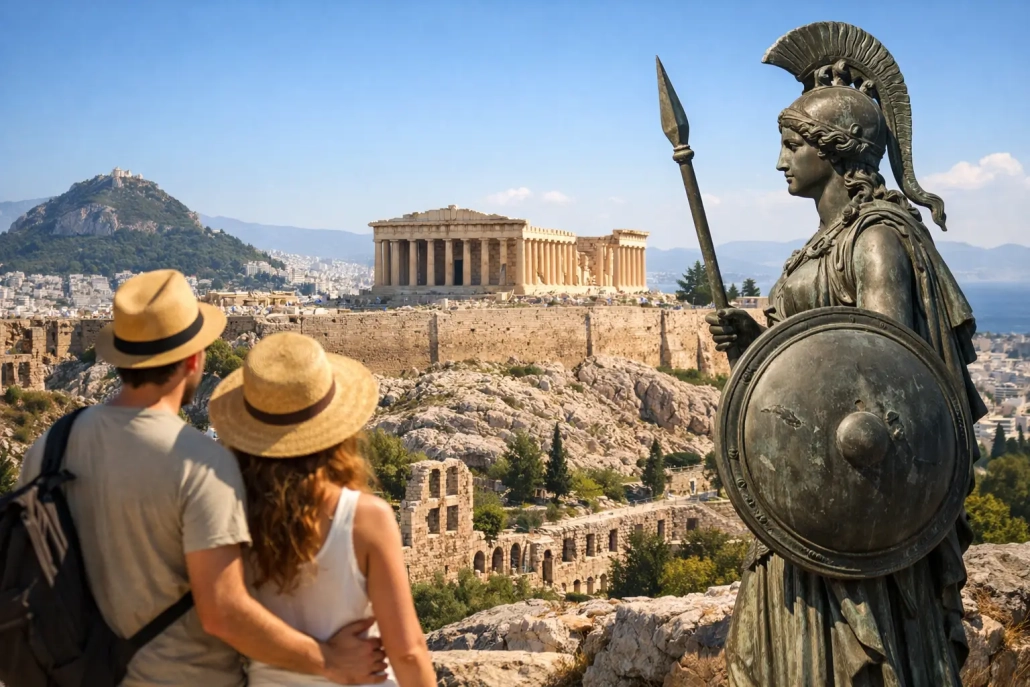
The Acropolis is more than marble rising above Athens. It is Athena’s city, the place where gods, heroes, rivalries, and rituals shaped the way ancient Athenians understood their world. A mythology tour Athens experience gives those stories their proper setting, turning familiar names such as Zeus, Athena, Poseidon, and Dionysus into a living thread that runs through the city’s monuments, neighborhoods, and landscapes.
For travelers with limited time, mythology is often the missing context between taking a photograph of the Parthenon and truly understanding why it was built. With a private guide and comfortable transportation, the day can be shaped around the stories that interest you most, without being tied to a large group’s schedule.
What Makes a Mythology Tour Athens Experience Different?
A standard Athens sightseeing tour may introduce the Acropolis, the Ancient Agora, and the Temple of Olympian Zeus. A mythology-focused experience goes further by asking why these places mattered to the people who built them. Rather than treating myths as decorative tales, a knowledgeable guide connects them to civic identity, religious practice, architecture, and politics.
At the Acropolis, for example, the story is not only that Athena won her contest with Poseidon. It is also about what that contest represented. Poseidon offered saltwater, while Athena offered the olive tree – a source of food, oil, timber, and trade. The myth reflects Athens’ relationship with its land, its economy, and the goddess the city chose as its protector.
This approach is especially rewarding for first-time visitors who want to make sense of the landmarks, as well as returning travelers who have already seen the major sights and want a more focused perspective. Families often find it a practical way to keep younger travelers engaged, since the stories of heroic quests, jealous gods, and strange creatures give ancient ruins a human pulse.
The Mythological Places That Matter Most
The Acropolis and the Parthenon
No mythology itinerary in Athens should rush the Acropolis. The Parthenon was dedicated to Athena Parthenos, Athena the Virgin, and its sculptural decoration once presented a carefully chosen world of gods, giants, heroes, and civic ceremony. A guide can point out how myth and public life were inseparable here.
The Erechtheion adds another layer. This elegant temple is linked to the contest between Athena and Poseidon, the sacred olive tree, and the city’s early legendary kings. It is one of the best places to understand that Greek mythology was not a single, fixed collection of stories. Local traditions mattered, and Athenians had their own versions of the divine past.
Because the Acropolis can be crowded, timing makes a real difference. An early private visit is often the best choice in warmer months, offering cooler temperatures, clearer light, and a calmer atmosphere before the busiest arrival period.
The Ancient Agora and the Gods of Daily Life
Below the Acropolis, the Ancient Agora shows a different side of mythological Athens. This was a marketplace, political center, and gathering place, but it was also a sacred landscape. The well-preserved Temple of Hephaestus honors the god of fire, craftsmanship, and metalworking.
Hephaestus is an especially fitting presence in this part of the city. The surrounding area was associated with artisans and workshops, making the temple a reminder that the gods were connected not only to epic adventures but also to the work that sustained daily life. Here, mythology becomes tangible in the practical world of ancient Athenians.
The Temple of Olympian Zeus
The immense columns of the Temple of Olympian Zeus offer a powerful contrast to the Acropolis. Dedicated to the king of the gods, this ambitious sanctuary was built over centuries and completed under the Roman emperor Hadrian. Its scale tells visitors something important about Zeus: he was not simply a character in a story, but a divine authority whose worship carried prestige across the Greek and Roman worlds.
A mythology tour can also connect this stop with nearby Hadrian’s Arch and the larger question of how later rulers used Greek religious traditions to establish their own status. The best tours do not separate myth from history. They show where the two meet.
Dionysus, Theater, and the Art of Storytelling
The Theater of Dionysus, on the southern slope of the Acropolis, deserves more than a passing glance. Dionysus was the god of wine, celebration, transformation, and theater. The tragedies and comedies performed here brought myth before the public in a form that could be moving, political, funny, and deeply unsettling.
This is where stories of Oedipus, Medea, Agamemnon, and Antigone became shared cultural experiences. A guide who understands both mythology and classical history can explain why these tales still feel immediate. They confront family loyalty, power, grief, justice, and the consequences of human pride – subjects that have never become outdated.
Why a Private Tour Adds Real Value
Athens is compact in parts, but its terrain, heat, crowds, and traffic can make a self-guided mythology day more demanding than it appears on a map. Private transportation removes the uncertainty between sites, while an expert guide makes better use of the time at each stop.
The strongest advantage is flexibility. A couple interested in Athena and ancient religion may spend longer at the Acropolis and Agora. A family may prefer a livelier route built around Hercules, the Minotaur, Perseus, and the Olympian gods. Cruise passengers arriving at Piraeus may need an itinerary planned precisely around their ship’s schedule. There is no single perfect mythology tour because the ideal pace depends on your interests, mobility, available hours, and travel season.
A private experience also allows for thoughtful adjustments on the day. If midday heat is intense, outdoor sites can be scheduled early and a museum stop or a leisurely Greek lunch can provide a welcome break. If an unexpected closure affects one monument, a local team can adapt the route without leaving you to solve the problem on your own.
At Timeless Athens Tours, private travel is designed around that kind of personal attention: licensed local professionals, premium Mercedes vehicles, clear fixed pricing, and an itinerary that respects both the stories you want to hear and the pace you want to keep.
How to Plan the Right Mythology-Focused Day
Start by deciding whether mythology is the main purpose of your day or a richer lens for seeing Athens’ essential landmarks. For most first-time visitors, a half-day or full-day route centered on the Acropolis, the Ancient Agora, the Theater of Dionysus, and the Temple of Olympian Zeus provides an excellent foundation. A longer stay can add the National Archaeological Museum or a thematic visit to Cape Sounion, where the Temple of Poseidon stands above the Aegean Sea.
Cape Sounion is a particularly memorable option for travelers who want mythology paired with scenery. The temple’s association with Poseidon and the legend of King Aegeus add meaning to its dramatic coastal location. It does require more driving time than central Athens, so it works best as a separate afternoon or day trip rather than a rushed addition to an Acropolis morning.
When booking, ask what is included in the guiding service, whether site admission is separate, how much walking is expected, and whether the itinerary can be adjusted for children, seniors, or guests with mobility concerns. Transparent answers matter. Premium service should feel relaxed, not complicated.
The Stories You Will Remember After the Ruins
The best mythology tours leave room for uncertainty as well as wonder. Greek myths have multiple versions, and ancient sources often disagree. That is part of their appeal. A skilled guide can explain the variations without flattening them into one simple script, helping you appreciate mythology as a tradition that changed across centuries.
You may arrive hoping to see the Parthenon and leave thinking about Athena’s olive tree. You may expect grand tales of Zeus and remember instead the quiet temple of Hephaestus, where a god of craft stood close to the working life of the city. These are the details that turn Athens from a checklist of ancient sites into a place with character, memory, and meaning.
Choose a tour that gives the stories enough time to breathe. When the guide, route, and pace are right, the gods of Athens feel less distant – and the city stays with you long after the journey home.


Leave a Reply
Want to join the discussion?Feel free to contribute!