
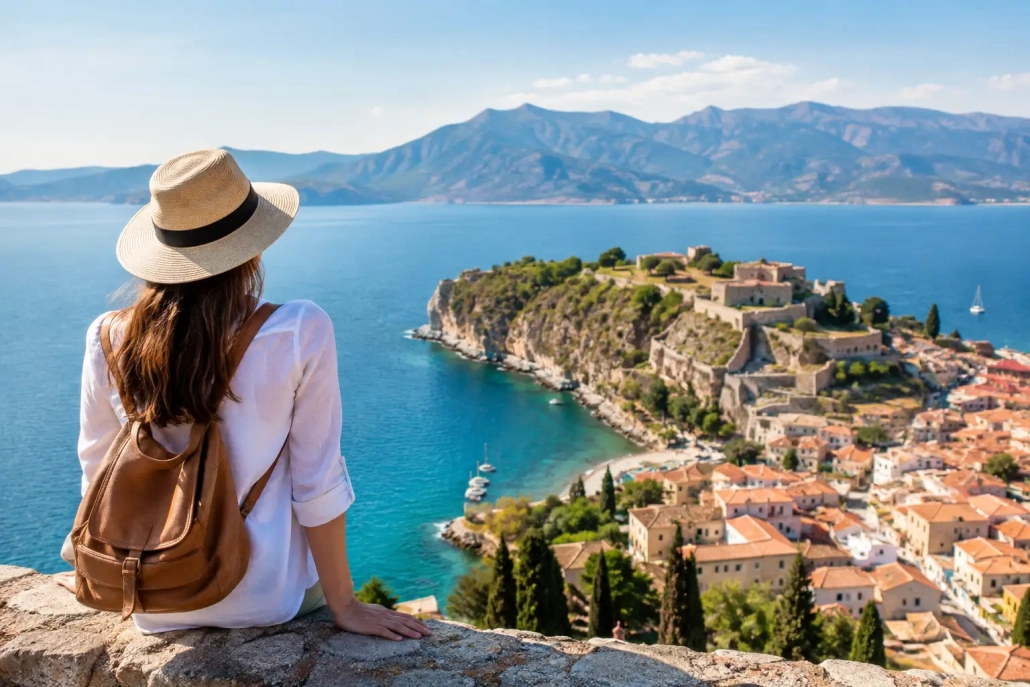
A 7-Day Peloponnese Itinerary Example for Greece
A well-planned Peloponnese itinerary example should feel like a journey through the chapters of Greece itself: the engineering ambition of Ancient Corinth, the royal power of Mycenae, Venetian elegance in Nafplion, Byzantine splendor in Mystras, and the birthplace of the Olympic Games. The challenge is not finding places worth seeing. It is deciding what deserves your time without turning a remarkable road trip into a race from one archaeological site to the next.
For travelers beginning in Athens, seven days is an excellent introduction to the peninsula. It allows for major landmarks, beautiful overnight stops, and enough flexibility to linger over a waterfront lunch or take in a view that was not on the original plan. With a private driver and a premium Mercedes vehicle, the long drives become part of the experience rather than a logistical concern.
A 7-Day Peloponnese Itinerary Example
This route begins and ends in Athens, following a broad loop through the northeastern Peloponnese, Laconia, the Mani Peninsula, and ancient Olympia. It is designed for couples, families, and small private groups who value comfort, meaningful storytelling, and a sensible pace.
Day 1: Athens to Corinth, Mycenae, and Nafplion
Leave Athens in the morning and cross the Corinth Canal, one of the most impressive engineering works of the 19th century. The narrow channel cuts through solid rock and connects the Aegean with the Ionian Sea, creating a memorable first stop before the ancient world begins in earnest.
Continue to Ancient Corinth, where St. Paul lived and preached during his travels in Greece. The Temple of Apollo, the Roman Agora, and the site museum offer powerful context for visitors interested in classical history, Roman Greece, and early Christianity.
From Corinth, travel south to Mycenae. Enter through the monumental Lion Gate, walk among the Cyclopean walls, and see the Treasury of Atreus. This was the kingdom associated with Agamemnon and the Trojan War, and its scale still feels extraordinary more than 3,000 years later.
Your overnight destination is Nafplion, one of Greece’s most graceful seaside towns. Its old quarter, neoclassical streets, waterfront promenade, and hilltop Palamidi Fortress make it an ideal first base. Enjoy dinner in the old town and settle in for two nights.
Day 2: Epidaurus and the Charm of Nafplion
After breakfast, drive through the Argolis countryside to the Ancient Theater of Epidaurus. Known for its exceptional acoustics, the theater once welcomed thousands of spectators for drama, music, and religious festivals connected to the sanctuary of Asklepios, the god of healing.
A licensed guide can add real depth here, explaining why Epidaurus was more than a theater. It was one of the ancient Mediterranean’s most important healing centers, where medicine, faith, architecture, and ritual came together.
Return to Nafplion for an unhurried afternoon. You may choose to visit Palamidi Fortress for its commanding views over the Argolic Gulf, take a short boat ride toward Bourtzi Castle, or simply enjoy the cafes and shops around Syntagma Square. This lighter day is intentional. After major archaeological sites, Nafplion gives the itinerary room to breathe.
Day 3: Mystras and Monemvasia
Today moves south into Laconia, a region of mountain landscapes and Byzantine heritage. The main destination is Mystras, the fortified medieval city set on the slopes below Mount Taygetus. Once a major center of the Byzantine Empire, Mystras contains palaces, monasteries, churches, frescoes, and extraordinary views across the Spartan plain.
Mystras requires some walking on uneven ground, so comfortable shoes are essential. Travelers with limited mobility can still enjoy selected areas and the atmosphere of the site, but this is one day where a flexible private itinerary is particularly valuable.
Continue east to Monemvasia, often called Greece’s stone castle town. Connected to the mainland by a narrow causeway, its hidden medieval settlement is built into the side of a dramatic sea rock. Spend the night either within the castle town or nearby, depending on your preferred level of convenience and atmosphere.
Day 4: Monemvasia to the Mani Peninsula
Begin the morning inside Monemvasia before the day-trippers arrive. Walk its cobbled lanes, visit the Church of Elkomenos Christos, and follow the path upward for views that reveal why this location was so strategically important for centuries.
Then turn west toward the Mani Peninsula, one of mainland Greece’s most distinctive regions. The road is scenic and the distances are not short, but the rewards are substantial: wild coastline, stone villages, defensive tower houses, and a culture shaped by independence and family loyalty.
Areopoli is a practical overnight stop, with character and easy access to the southern Mani. If you prefer natural wonders, include the nearby Diros Caves, where visitors travel through an underground waterway surrounded by stalactites and mineral formations. Cave conditions and operating hours can vary, so this is a stop best confirmed in advance.
Day 5: Mani Villages, Kalamata, and Ancient Messene
The Mani is best appreciated slowly. Depending on your interests, the morning can include traditional settlements such as Limeni or Kardamyli, a swim in clear coastal water during warmer months, or a scenic drive through the Inner Mani’s stark, beautiful terrain.
Later, travel toward Kalamata, a lively coastal city better known internationally for its olives than for its cultural appeal. It is a welcoming place for lunch and offers a pleasant contrast to the remote villages of Mani.
In the afternoon, visit Ancient Messene. Often less crowded than Mycenae or Epidaurus, it is among the Peloponnese’s most rewarding archaeological sites. Its remarkably preserved stadium, theater, temples, city walls, and public buildings give visitors a vivid sense of an ancient city as a functioning whole, not just a collection of ruins.
Overnight near Kalamata or Messene. This placement shortens the following day’s journey to Olympia.
Day 6: Through Arcadia to Ancient Olympia
Drive northwest through the interior of the Peloponnese, where the landscape becomes greener and more mountainous. This is Arcadia, a region long associated with pastoral beauty in poetry and mythology. The route can be adjusted to include a mountain village coffee stop or a traditional lunch, particularly for travelers who enjoy local food and quieter scenery.
Arrive in Ancient Olympia in the afternoon. This is where the original Olympic Games began in 776 BC, honoring Zeus and bringing together athletes from competing Greek city-states. Walk through the ancient stadium, see the Temple of Zeus where the monumental statue of Zeus once stood, and visit the archaeological museum for masterpieces including the Hermes of Praxiteles.
Olympia is best experienced with context. The site is not only about sport. It tells a story of religion, politics, artistic achievement, and the ideal of peaceful competition that still resonates today.
Day 7: Olympia to Athens
The final drive back to Athens takes several hours, so it is wise to begin at a comfortable but timely hour. Travelers flying out the same evening should allow a generous buffer, while those remaining in Athens can arrange drop-off directly at their hotel, Piraeus cruise terminal, or Athens International Airport.
If time allows, a stop in the mountain town of Dimitsana or at the Temple of Apollo Epicurius at Bassae can be considered. However, adding both to the return day makes the schedule demanding. For most visitors, it is better to protect the comfort of the journey and arrive in Athens without feeling rushed.
How to Adapt This Peloponnese Itinerary
No single route suits every traveler. History enthusiasts may want additional time in Mycenae, Mystras, and Olympia. Families with younger children may prefer more time in Nafplion and on the beaches near Mani. Cruise guests with only one or two days should focus on Corinth, Mycenae, Epidaurus, and Nafplion rather than attempting the full peninsula.
Monemvasia and Mani are the key trade-off in a seven-day plan. Both are unforgettable, but they add driving time. If you prefer a slower pace, remove Monemvasia and spend an extra night in Nafplion or Kalamata. If Byzantine history and dramatic medieval scenery are priorities, keep Monemvasia and accept a fuller route.
A private tour makes these choices easier. Rather than following a fixed coach timetable, you can adjust departure times, choose the sites that matter most, pause for photographs, and enjoy Greece with a knowledgeable local driver who understands the roads and rhythm of the region. Timeless Athens Tours can arrange a tailor-made Peloponnese journey with premium transportation, experienced drivers, and licensed guides where historical interpretation will enrich your visit.
The Peloponnese rewards travelers who give it more than a passing glance. Plan thoughtfully, leave room for the unexpected village square or sea view, and let each stop reveal another layer of Greece’s enduring story.


Leave a Reply
Want to join the discussion?Feel free to contribute!