News & Blog Posts
Timeless Athens Tours & Shore Excursions within Greece


The Acropolis is not simply Athens’ signature view. It is the place where the ideals of fifth-century BC Athens became stone: democracy, civic ambition, artistic confidence, and devotion to Athena. A well-planned classical Greece itinerary should begin here, then follow those ideas beyond the capital to sanctuaries, theaters, athletic grounds, and powerful ancient kingdoms across the Peloponnese and central Greece.
Seven days gives you time to experience these places with context rather than treating Greece as a collection of photo stops. This route is designed for travelers who value comfort, expert insight, and the freedom to adjust the day around their interests. It combines the essential ancient sites with scenic overnight stays, avoiding the exhausting pace of a large bus tour.
Athens, the Argolid, Olympia, and Delphi form the most rewarding core route for a first classical journey through mainland Greece. They tell different parts of the Greek story. Athens shows the height of the Classical age; Mycenae reaches further back into the Bronze Age foundations of Greek myth; Olympia reveals the sacred and athletic traditions shared by the Greek city-states; and Delphi brings you to the spiritual center where leaders sought Apollo’s counsel.
A shorter trip can cover Athens and one or two day excursions, but seven days allows for overnight stays in Nafplion, Olympia, and Delphi. Those overnights matter. They turn long drives into a relaxed road journey and leave room for a proper meal, an unhurried museum visit, and a walk through towns that still feel connected to their landscapes.
Begin early at the Acropolis, before the strongest heat and the largest crowds. The Parthenon, Erechtheion, Propylaea, and Temple of Athena Nike deserve more than a quick circuit. With an expert licensed guide, details that are easy to miss become meaningful: the optical refinements of the Parthenon, the political purpose of the Acropolis, and the changing uses of the hill from antiquity through the modern era.
Continue downhill to the Ancient Agora, the civic heart of ancient Athens. This is where public life happened – where Athenians debated, traded, served on juries, and encountered the ideas that shaped Western political thought. The remarkably preserved Temple of Hephaestus offers one of the clearest impressions of a complete ancient Greek temple.
Spend the evening in Plaka or beneath the Acropolis in Makrygianni. A private driver can keep the day efficient, particularly for families, cruise guests, or travelers arriving after an overnight flight, while allowing you to set your own pace between visits.
Use your second day to give the monuments their proper historical framework. The Acropolis Museum is the natural choice, with its original sculptures, architectural fragments, and galleries that explain how the Acropolis was built and experienced. Travelers with a deeper interest in Greek art and archaeology may prefer to add the National Archaeological Museum, though seeing both in one day can feel rushed.
In the afternoon, travel along the Athenian Riviera to Cape Sounion. The Temple of Poseidon stands high above the Aegean, where sea, mythology, and architecture meet in one unforgettable setting. It is especially appealing near sunset, but timing depends on the season and your preference for a quieter visit versus dramatic golden-hour views.
This is also a sensible day to keep flexible. If jet lag, a delayed flight, or a cruise schedule affects your plans, Cape Sounion can be moved to your final day without disrupting the main route.
Leave Athens for the Peloponnese, beginning with a stop at the Corinth Canal. Although the canal itself is modern, it offers a striking introduction to the narrow isthmus that made Corinth strategically vital in antiquity. Nearby Ancient Corinth preserves the city that controlled trade between mainland Greece and the Peloponnese, with the Temple of Apollo as its defining landmark.
From Corinth, continue to Mycenae. Strictly speaking, Mycenae predates the Classical era by centuries, yet no classical Greece itinerary is complete without it. The Lion Gate, Cyclopean walls, royal tombs, and palace remains provide the mythic background to Homer’s Agamemnon and the Greek world that followed.
The afternoon belongs to Epidaurus, home to the Sanctuary of Asclepius and its celebrated fourth-century BC theater. The theater’s acoustics are impressive, but its significance goes beyond engineering. This was a place of healing, worship, performance, and pilgrimage.
Overnight in Nafplion, one of Greece’s most graceful seafront towns. Its Venetian lanes, harborfront promenade, and views toward the Argolic Gulf provide a welcome contrast to a day among ancient ruins.
Do not rush out of Nafplion at dawn. A relaxed morning gives you time to see the old town, stroll the waterfront, or visit Palamidi Fortress if you enjoy a climb and sweeping views. Then travel west through the Peloponnese toward Olympia, with the route chosen according to your preferred pace and any stops you would like to make along the way.
This transfer day is where private travel makes a real difference. Public transportation between archaeological centers is possible but time-consuming, while fixed group schedules leave little room for a village lunch or an unscheduled scenic pause. A premium Mercedes vehicle, experienced local driver, and transparent plan make the road portion part of the experience rather than a logistical hurdle.
Arrive in Olympia with time for dinner and a restful evening. The small modern town is straightforward and welcoming, and an overnight here lets you visit the sanctuary early the next morning.
Ancient Olympia was not a city-state in the usual sense. It was a Panhellenic sanctuary, where Greeks from rival communities gathered to honor Zeus and compete in the games that began in 776 BC. Walk through the Altis to see the Temple of Zeus, once home to one of the Seven Wonders of the Ancient World, the Temple of Hera, the training grounds, and the original stadium.
The Archaeological Museum of Olympia is essential. Its sculptural pediments and the statue of Hermes by Praxiteles help visitors understand the artistic sophistication that ruins alone cannot fully convey.
After lunch, continue north toward Delphi. This is one of the longer drives of the route, so it is best approached realistically. Travelers who want more time at Olympia can add an eighth day; those comfortable with a scenic afternoon transfer will find the journey rewarding, especially as the landscape shifts toward the mountains of central Greece.
Overnight in Delphi or nearby Arachova. Arachova has a livelier mountain-village atmosphere, while Delphi places you closer to the archaeological site. The better choice depends on whether you prioritize evening dining options or an early start among the ruins.
Delphi was considered the navel of the ancient world. Kings, generals, and city-state representatives came to consult the oracle of Apollo, bringing offerings that turned the sanctuary into a display of wealth, rivalry, faith, and diplomacy.
Visit the Sacred Way, the Temple of Apollo, the Athenian Treasury, the theater, and the stadium. The setting on the slopes of Mount Parnassus is as powerful as the monuments themselves, looking across the olive groves of the Pleistos Valley toward the Corinthian Gulf. The Delphi Archaeological Museum completes the visit, particularly through the Charioteer of Delphi and the Sphinx of Naxos.
Return to Athens in the afternoon or evening. The drive generally takes around three hours without extended stops, making this a comfortable final transfer when handled privately. Timeless Athens Tours can tailor the return around a late flight, a hotel check-in, or a final dinner reservation in Athens.
Your last day should reflect what has captured your interest during the week. Art lovers may want more time at the National Archaeological Museum. Travelers fascinated by civic life can explore Kerameikos, the ancient cemetery, and nearby neighborhoods with fewer crowds than the Acropolis area. Families may prefer a relaxed morning of shopping, a Greek cooking experience, or a coastal lunch before airport transfer.
If your flight leaves later in the day, Cape Sounion is an excellent final outing. If you are departing from Piraeus after a cruise extension, allow generous time for port transfer rather than risking a tight schedule. Greece rewards curiosity, but it also rewards sensible timing.
The best months for this route are generally April through early June and September through October, when temperatures are more comfortable for outdoor sites and roads are less busy than peak summer. July and August remain possible, but early departures, shaded breaks, and a vehicle with strong air conditioning become particularly valuable.
For most travelers, a private guide is most beneficial at the major archaeological sites, while a professional driver provides comfort and local knowledge between destinations. Some visitors prefer a driver-guide throughout; others choose licensed guides in Athens, Olympia, and Delphi for more detailed interpretation. There is no single right arrangement – it depends on how deeply you want to study the sites and how independently you enjoy exploring.
Pack shoes with reliable grip, sun protection, a refillable water bottle, and a light layer for Delphi, where mountain weather can be cooler than Athens. Most importantly, resist the urge to add Meteora, Santorini, or too many islands to this seven-day route. They are exceptional destinations, but they deserve their own time. A carefully paced mainland journey lets Classical Greece speak in full sentences, not hurried fragments.
When you stand in Delphi’s mountain silence or on the worn starting line at Olympia, leave a little space in the schedule. The most memorable moments in Greece are often the ones no itinerary can fully predict.

A well-planned Peloponnese itinerary example should feel like a journey through the chapters of Greece itself: the engineering ambition of Ancient Corinth, the royal power of Mycenae, Venetian elegance in Nafplion, Byzantine splendor in Mystras, and the birthplace of the Olympic Games. The challenge is not finding places worth seeing. It is deciding what deserves your time without turning a remarkable road trip into a race from one archaeological site to the next.
For travelers beginning in Athens, seven days is an excellent introduction to the peninsula. It allows for major landmarks, beautiful overnight stops, and enough flexibility to linger over a waterfront lunch or take in a view that was not on the original plan. With a private driver and a premium Mercedes vehicle, the long drives become part of the experience rather than a logistical concern.
This route begins and ends in Athens, following a broad loop through the northeastern Peloponnese, Laconia, the Mani Peninsula, and ancient Olympia. It is designed for couples, families, and small private groups who value comfort, meaningful storytelling, and a sensible pace.
Leave Athens in the morning and cross the Corinth Canal, one of the most impressive engineering works of the 19th century. The narrow channel cuts through solid rock and connects the Aegean with the Ionian Sea, creating a memorable first stop before the ancient world begins in earnest.
Continue to Ancient Corinth, where St. Paul lived and preached during his travels in Greece. The Temple of Apollo, the Roman Agora, and the site museum offer powerful context for visitors interested in classical history, Roman Greece, and early Christianity.
From Corinth, travel south to Mycenae. Enter through the monumental Lion Gate, walk among the Cyclopean walls, and see the Treasury of Atreus. This was the kingdom associated with Agamemnon and the Trojan War, and its scale still feels extraordinary more than 3,000 years later.
Your overnight destination is Nafplion, one of Greece’s most graceful seaside towns. Its old quarter, neoclassical streets, waterfront promenade, and hilltop Palamidi Fortress make it an ideal first base. Enjoy dinner in the old town and settle in for two nights.
After breakfast, drive through the Argolis countryside to the Ancient Theater of Epidaurus. Known for its exceptional acoustics, the theater once welcomed thousands of spectators for drama, music, and religious festivals connected to the sanctuary of Asklepios, the god of healing.
A licensed guide can add real depth here, explaining why Epidaurus was more than a theater. It was one of the ancient Mediterranean’s most important healing centers, where medicine, faith, architecture, and ritual came together.
Return to Nafplion for an unhurried afternoon. You may choose to visit Palamidi Fortress for its commanding views over the Argolic Gulf, take a short boat ride toward Bourtzi Castle, or simply enjoy the cafes and shops around Syntagma Square. This lighter day is intentional. After major archaeological sites, Nafplion gives the itinerary room to breathe.
Today moves south into Laconia, a region of mountain landscapes and Byzantine heritage. The main destination is Mystras, the fortified medieval city set on the slopes below Mount Taygetus. Once a major center of the Byzantine Empire, Mystras contains palaces, monasteries, churches, frescoes, and extraordinary views across the Spartan plain.
Mystras requires some walking on uneven ground, so comfortable shoes are essential. Travelers with limited mobility can still enjoy selected areas and the atmosphere of the site, but this is one day where a flexible private itinerary is particularly valuable.
Continue east to Monemvasia, often called Greece’s stone castle town. Connected to the mainland by a narrow causeway, its hidden medieval settlement is built into the side of a dramatic sea rock. Spend the night either within the castle town or nearby, depending on your preferred level of convenience and atmosphere.
Begin the morning inside Monemvasia before the day-trippers arrive. Walk its cobbled lanes, visit the Church of Elkomenos Christos, and follow the path upward for views that reveal why this location was so strategically important for centuries.
Then turn west toward the Mani Peninsula, one of mainland Greece’s most distinctive regions. The road is scenic and the distances are not short, but the rewards are substantial: wild coastline, stone villages, defensive tower houses, and a culture shaped by independence and family loyalty.
Areopoli is a practical overnight stop, with character and easy access to the southern Mani. If you prefer natural wonders, include the nearby Diros Caves, where visitors travel through an underground waterway surrounded by stalactites and mineral formations. Cave conditions and operating hours can vary, so this is a stop best confirmed in advance.
The Mani is best appreciated slowly. Depending on your interests, the morning can include traditional settlements such as Limeni or Kardamyli, a swim in clear coastal water during warmer months, or a scenic drive through the Inner Mani’s stark, beautiful terrain.
Later, travel toward Kalamata, a lively coastal city better known internationally for its olives than for its cultural appeal. It is a welcoming place for lunch and offers a pleasant contrast to the remote villages of Mani.
In the afternoon, visit Ancient Messene. Often less crowded than Mycenae or Epidaurus, it is among the Peloponnese’s most rewarding archaeological sites. Its remarkably preserved stadium, theater, temples, city walls, and public buildings give visitors a vivid sense of an ancient city as a functioning whole, not just a collection of ruins.
Overnight near Kalamata or Messene. This placement shortens the following day’s journey to Olympia.
Drive northwest through the interior of the Peloponnese, where the landscape becomes greener and more mountainous. This is Arcadia, a region long associated with pastoral beauty in poetry and mythology. The route can be adjusted to include a mountain village coffee stop or a traditional lunch, particularly for travelers who enjoy local food and quieter scenery.
Arrive in Ancient Olympia in the afternoon. This is where the original Olympic Games began in 776 BC, honoring Zeus and bringing together athletes from competing Greek city-states. Walk through the ancient stadium, see the Temple of Zeus where the monumental statue of Zeus once stood, and visit the archaeological museum for masterpieces including the Hermes of Praxiteles.
Olympia is best experienced with context. The site is not only about sport. It tells a story of religion, politics, artistic achievement, and the ideal of peaceful competition that still resonates today.
The final drive back to Athens takes several hours, so it is wise to begin at a comfortable but timely hour. Travelers flying out the same evening should allow a generous buffer, while those remaining in Athens can arrange drop-off directly at their hotel, Piraeus cruise terminal, or Athens International Airport.
If time allows, a stop in the mountain town of Dimitsana or at the Temple of Apollo Epicurius at Bassae can be considered. However, adding both to the return day makes the schedule demanding. For most visitors, it is better to protect the comfort of the journey and arrive in Athens without feeling rushed.
No single route suits every traveler. History enthusiasts may want additional time in Mycenae, Mystras, and Olympia. Families with younger children may prefer more time in Nafplion and on the beaches near Mani. Cruise guests with only one or two days should focus on Corinth, Mycenae, Epidaurus, and Nafplion rather than attempting the full peninsula.
Monemvasia and Mani are the key trade-off in a seven-day plan. Both are unforgettable, but they add driving time. If you prefer a slower pace, remove Monemvasia and spend an extra night in Nafplion or Kalamata. If Byzantine history and dramatic medieval scenery are priorities, keep Monemvasia and accept a fuller route.
A private tour makes these choices easier. Rather than following a fixed coach timetable, you can adjust departure times, choose the sites that matter most, pause for photographs, and enjoy Greece with a knowledgeable local driver who understands the roads and rhythm of the region. Timeless Athens Tours can arrange a tailor-made Peloponnese journey with premium transportation, experienced drivers, and licensed guides where historical interpretation will enrich your visit.
The Peloponnese rewards travelers who give it more than a passing glance. Plan thoughtfully, leave room for the unexpected village square or sea view, and let each stop reveal another layer of Greece’s enduring story.

Your time in Greece is too valuable to spend standing in a crowded meeting point, straining to hear a guide, or discovering halfway through the day that the itinerary does not match what you came to see. Choosing a Greek tour guide is not simply about finding someone who can point out the Parthenon. It is about choosing the person and service that will shape how you experience Athens, the Acropolis, Delphi, Meteora, Corinth, or the Peloponnese.
For many visitors, especially cruise guests and first-time travelers, a private guide or carefully planned private tour turns a complicated day into a relaxed, meaningful experience. The right choice depends on your interests, schedule, group size, and how much flexibility you want along the way.
Before comparing guides, decide what you want your day in Greece to feel like. Some travelers want a focused historical experience at the Acropolis, Acropolis Museum, and ancient Agora. Others want a broader Athens city tour with panoramic viewpoints, changing-of-the-guard stops, neighborhood walks, and time for lunch. Families may prefer a pace that leaves room for breaks, while couples may prioritize scenic drives, local food, or a sunset stop.
This matters because not every guide or tour company works in the same way. A large group excursion follows a fixed route and timetable. It can be a good fit if price is the only priority and you are comfortable moving at the group’s pace. A private experience is better suited to travelers who want their day tailored around their own priorities, whether that means more mythology, less museum time, accessible walking routes, or an early return to a cruise ship.
For longer day trips, the difference becomes even more noticeable. Delphi deserves historical context and time to absorb its mountain setting. Meteora involves a long drive and benefits from thoughtful pacing. A visit to Mycenae, Epidaurus, and Nafplion needs a realistic route, not a rushed collection of photo stops.
One of the most useful questions when choosing a Greek tour guide is also one many travelers do not know to ask: will you have a licensed tourist guide at the archaeological site, or a professional driver providing commentary during transport?
Both roles add value, but they are different. A licensed guide has the professional credentials required to provide formal guided interpretation inside major archaeological sites and museums. Their expertise brings ancient Athens, Greek mythology, art, politics, and daily life into clear focus while you stand in the places where history unfolded.
A knowledgeable local driver can transform the journey between destinations. They know the roads, traffic patterns, practical timing, scenic routes, and the small details that make a private day run smoothly. They can offer local perspective, coordinate stops, and ensure you arrive comfortably and on time. For many private tours, the strongest arrangement is a premium vehicle and experienced local driver combined with an expert licensed guide where in-depth site interpretation is most valuable.
Ask clearly what is included. If a tour says “guided,” confirm whether it includes a licensed guide, a driver-guide, entrance assistance, or a combination of services. Clear answers are a sign of a dependable operator.
A memorable guide does more than recite facts. Greece has thousands of years of history, and the best storytelling helps you understand how the layers connect. At the Acropolis, that might mean linking the Parthenon’s architecture to Athenian democracy, religious life, and the changing identity of the city. At Thermopylae, it may mean separating legend from history while still honoring why the site resonates.
Ask about a guide’s areas of expertise if your interests are specific. Art history, mythology, Byzantine heritage, food culture, World War II history, and family-friendly storytelling all call for a slightly different approach. A quality private tour operator should be able to match you with the right professional or shape an itinerary around your theme.
In Athens, timing can change the entire experience. The Acropolis is most enjoyable when your visit is planned around heat, crowds, mobility needs, and your preferred pace. Cruise travelers arriving at Piraeus need a schedule built around the ship’s all-aboard time, not a generic city itinerary. Travelers arriving after an overnight flight may want a gentler first day with airport pickup, a panoramic drive, and a flexible lunch stop.
Ask how the operator handles these practical details. Do they monitor cruise schedules? Can they adjust pickup times? Is there enough time to return to Piraeus with a comfortable margin? What happens if your flight is delayed? An experienced local team plans for real travel conditions rather than assuming every day will run perfectly.
Transportation deserves the same attention. A premium, air-conditioned Mercedes vehicle is not an extra luxury after hours in the Greek sun or on a full-day route to Delphi or Meteora. It is part of the experience. For couples, families, and small groups, having room for everyone, reliable climate control, bottled water, and a professional chauffeur can make the difference between arriving tired and arriving ready to enjoy the next stop.
Reviews are useful, but the most helpful ones give details. Look beyond a high overall rating and notice what previous guests say about punctuality, communication, vehicle condition, itinerary flexibility, historical knowledge, and the way they were treated when plans changed.
A comment such as “great tour” is encouraging, but a review that explains how a guide adjusted an Acropolis visit around a child’s needs, helped a couple make their ship departure, or tailored a day trip to fit a limited schedule tells you much more. Consistent mentions of warmth, professionalism, and organization usually point to a service that understands hospitality, not just sightseeing.
It is also worth considering whether the operator regularly serves travelers like you. A private operator experienced with Piraeus shore excursions understands port timing. One that works with families knows that children need engagement, shade, and breaks. A company accustomed to custom itineraries will be more comfortable adapting a plan for a proposal, an anniversary, a multigenerational group, or a business guest with a narrow window of free time.
The lowest advertised rate is not always the best value. When comparing private tours, examine the complete picture: vehicle type, duration, driver, licensed guide services, pickup location, taxes, fuel, tolls, entrance fees, meal time, and any possible waiting charges. Transparent fixed pricing gives you confidence before you travel and protects the day from awkward surprises.
Private travel can be especially good value for families and small groups because the vehicle and planning are reserved for your party. You are not paying with lost time at multiple hotel pickups or waiting for a large group to gather. You can spend more time at the places that matter to you and less time managing logistics.
That does not mean every private tour needs to be packed with extras. If your goal is simply an efficient, comfortable transfer from Athens Airport to your hotel, choose a professional transfer service. If you want a deeper cultural day, invest in expert guidance where it adds the most meaning. The right level of service depends on the trip you are taking, not on a one-size-fits-all package.
A well-designed itinerary should feel organized without feeling rigid. Greece rewards curiosity. You may discover that you want longer at the Acropolis Museum, decide to linger over lunch in Nafplion, or prefer a quick scenic photo stop rather than another museum. A private tour should make room for those choices when timing allows.
Before booking, ask how much customization is possible. Can you add a stop at Cape Sounion? Can a half-day Athens tour be built around ancient sites and food rather than shopping? Can a mainland itinerary include a local village, a winery, or a child-friendly break? The response will tell you whether you are dealing with a genuine private travel partner or a fixed product presented as private.
At Timeless Athens Tours, the goal is not to move guests through a checklist. It is to pair local expertise, licensed guides when needed, comfortable premium transportation, and thoughtful planning so each day feels personal from pickup to return.
The best guide for your trip will have the credentials and planning skills to make the day easy, but the human connection matters too. You should feel comfortable asking questions, changing your mind, and saying what interests you. Great guides make room for curiosity. They know when to offer a fascinating story, when to give you quiet time to take in the view, and when to step in with practical help.
Book the service that listens carefully before you arrive. When your guide understands whether you are chasing ancient history, traveling with grandparents, arriving by ship, or celebrating something special, Greece stops feeling like a schedule of famous places and starts becoming your own story.
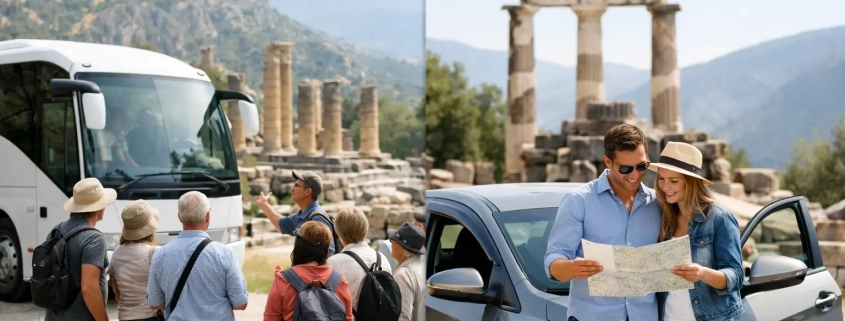
A Delphi day trip looks simple on a map: leave Athens, head northwest, visit the sanctuary, and return by evening. In reality, the Delphi tour versus rental car decision shapes far more than transportation. It determines how relaxed the day feels, how much history you absorb, whether you can enjoy mountain roads without worry, and how well the itinerary works for everyone in your party.
Delphi is one of Greece’s most rewarding full-day destinations, but it is not a quick drive around the corner. The route from Athens takes you through changing landscapes, from the plains of Boeotia to the slopes beneath Mount Parnassus. The archaeological site itself is layered, expansive, and full of stories that can be easy to miss without context. The best choice depends on how you prefer to travel, how much time you have, and whether the road is part of the adventure or simply the means to reach it.
A rental car gives you independence. A private Delphi tour gives you independence without putting one person in your group on driving, navigation, parking, timing, and route planning duty. Neither option is automatically right for every traveler, but the differences become clear once you look beyond the daily rental rate.
With a rental car, you control your departure time and can stop wherever you wish. Travelers who enjoy driving abroad, are comfortable with mountain roads, and plan to continue beyond Delphi may find this appealing. It can also make sense for visitors spending several days in central Greece, especially if they want to combine Delphi with overnight stays in Arachova, Galaxidi, or Meteora.
A private tour is designed for travelers who want to use a precious vacation day well. Your professional local driver manages the road while you enjoy the scenery, ask questions, rest between stops, and arrive with a plan that fits your pace. For couples, families, cruise guests, and small groups with limited time in Athens, that extra ease often has real value.
The drive from Athens to Delphi is generally about two and a half to three hours each way, depending on traffic and stops. That makes it a long day behind the wheel before you have walked uphill through the Sanctuary of Apollo, visited the museum, and explored the village.
On a self-drive trip, the driver may face five to six hours of concentration, unfamiliar road signs, tolls, fuel stops, and parking logistics. This is manageable for confident drivers, but it changes the day’s rhythm. After a full afternoon at the site, the return journey can feel longer than expected.
On a private tour, everyone arrives with the same energy. Your driver knows the route, the practical stopping points, and how to adjust the schedule around traffic or weather. Premium Mercedes vehicles also offer the comfort that matters on a full-day excursion: air conditioning, generous space, and a quiet place to recharge between destinations.
The greatest advantage of a private experience is not simply being driven. It is having a day arranged around your interests rather than a fixed bus schedule or a collection of travel tabs on your phone.
Delphi was considered the center of the ancient Greek world, the place where city-states, kings, and ordinary people sought the Oracle of Apollo. Seeing the Temple of Apollo is powerful. Understanding why the Sacred Way climbs through monuments from rival Greek cities, what the treasuries represented, and how the Pythia shaped political decisions makes the visit far more meaningful.
A knowledgeable driver can share local perspective throughout the route and help the day run smoothly. For guests who want deeper archaeological interpretation, a licensed guide can bring the site, museum, and mythology into focus. This is particularly valuable at the Delphi Museum, where masterpieces such as the Charioteer of Delphi reward more than a quick glance.
Private travel also leaves room for the moments that group tours often miss. You may pause at Hosios Loukas area viewpoints, choose a relaxed lunch in Arachova, or spend longer in the museum if ancient bronze work and sculpture are your passion. If you are traveling with children, mobility needs, or different attention spans in the same group, that flexibility is more than a luxury. It is what keeps the day enjoyable.
Timeless Athens Tours can tailor a Delphi day trip around your schedule, group size, and preferred balance of archaeology, scenery, dining, and free time. Fixed transparent pricing helps you understand the arrangement before the day begins, without surprises caused by changing taxi fares or last-minute transport decisions.
A rental car should not be dismissed simply because a private tour is more convenient. For some travelers, driving is part of the pleasure. If you are extending your trip through mainland Greece, a car may be the practical choice for multiple destinations and overnight stays.
It can be a good fit if you are used to driving internationally, comfortable navigating roads that become more winding as you approach the mountain region, and willing to research parking, tolls, fuel policies, and insurance coverage. A car also allows spontaneous detours, although travelers should be realistic about daylight hours and the time needed to experience Delphi properly.
Budget is another legitimate consideration. For a solo traveler or a couple focused strictly on the lowest possible cash expense, a rental car can appear less expensive at first. But compare the complete cost: daily rental, insurance, fuel, tolls, parking, meals during a longer self-planned day, and the possible expense of hotel parking if you keep the vehicle overnight. The price gap can narrow quickly.
There is also the question of responsibility. Some guests genuinely enjoy route planning. Others would rather look out the window as the landscape shifts from Athens to olive groves and mountains. Know which traveler you are before booking.
Delphi is a hillside destination, not a large city with endless parking garages. Spaces near the archaeological area can be limited during busy periods, and the village streets are narrow. You will also need to coordinate your own arrival with site and museum opening hours, ticket procedures, and seasonal conditions.
A professional driver handles the practical rhythm of the visit. That does not mean rushing through the experience. It means arriving at a sensible time, knowing where drop-offs and pickups work best, and keeping the day focused on Delphi rather than logistics.
The right comparison is not “tour price versus car price.” It is “what does each option give our group for the day?” A private vehicle may cost more than the base rate of a rental, yet it can offer better value when divided among a family or small group. It includes dedicated transportation, door-to-door pickup from Athens, a driver who knows the route, and the freedom to personalize the day.
For cruise passengers arriving at Piraeus, a private tour is often the safer choice. Ship schedules are firm, and a delayed return can create unnecessary stress. For travelers with only a few days in Athens, it also protects time and energy that would otherwise go into navigating an unfamiliar route.
A rental car remains compelling for independent travelers on a longer road trip. Just leave a generous margin in the schedule. Delphi deserves more than a rushed photo at the Temple of Apollo before a tired drive back to Athens.
Start with your itinerary. Are you returning to Athens that evening, or continuing through central Greece? Then consider your group: Will everyone be comfortable after a long drive, and does anyone need extra flexibility for walking pace, meals, or rest stops?
Think honestly about your interest in history as well. If Delphi is a once-in-a-lifetime visit and you want to understand the Oracle, the ancient games, and the meaning behind the monuments, expert insight can transform the experience. If your goal is independent exploration over several days, a rental car may suit your travel style better.
Finally, consider what you want to remember. Most travelers do not return from Delphi talking about toll booths or parking spaces. They remember the mountain light, the ruins rising above the valley, the Charioteer’s remarkable expression, and the sense of standing where ancient Greece once came to ask the gods for guidance. Choose the option that leaves you most free to enjoy those moments.

The Acropolis is not a monument you should rush through with one eye on a map and the other on the clock. It is a steep, sunlit hill where the Parthenon, the Erechtheion, the Propylaea, and the Temple of Athena Nike reveal different chapters of Athens at every turn. This Acropolis tour review looks at whether a private guided visit is worth choosing, particularly for travelers with limited time, families, cruise schedules, or a wish to understand more than the view.
For many visitors, the answer is yes – but not because a private tour simply feels more exclusive. The real value is context, pace, and practical ease. A skilled licensed guide can turn weathered marble and distant ruins into a coherent story of democracy, mythology, architecture, war, and restoration. A private driver and comfortable vehicle can also make the beginning and end of the visit considerably easier in a busy city.
The Acropolis is manageable on your own, especially if you enjoy researching history beforehand and are comfortable navigating Athens independently. Timed entry has made access more structured than it once was, and the main path is clearly marked. Still, independent visitors often spend much of their visit asking the same questions: Which building am I looking at? Why is part of it new? Where is the best viewpoint? How does this relate to the ancient Agora or the Acropolis Museum below?
A private guided tour answers those questions in the moment, and it adapts to what interests you. A family with teenagers may want the mythology behind Athena and Poseidon, along with time for photographs. A couple interested in art and architecture may prefer a closer look at the Parthenon’s visual refinements, the Caryatids, and the long debate around conservation. Cruise guests may need an efficient route that accounts for the drive from Piraeus and a firm return time to the ship.
That flexibility matters because no two visits feel the same. Summer heat, a crowded entrance, mobility needs, and a late-arriving flight can all affect the ideal plan. Unlike a large bus group, a private experience can adjust the order of the day without leaving guests behind or forcing them to follow a fixed script.
The Parthenon can be admired in silence, but its meaning becomes richer when its design is explained. A knowledgeable guide can point out why its columns appear straight even though they are subtly curved, how its sculptures communicated civic identity, and why the building has served different purposes over nearly 2,500 years. These details give the site weight without turning the experience into a lecture.
The same is true of the Erechtheion. Many visitors recognize the Porch of the Caryatids from photographs. Fewer realize that the building brings together several sacred traditions in one unusual design, including the contest between Athena and Poseidon for the patronage of Athens. Good guiding connects such stories to the landscape in front of you.
For travelers who already know Greek history well, the benefit is more selective. Request a thematic focus – classical architecture, archaeology, mythology, women in ancient Athens, or the modern restoration program. A private tour should not feel like a standard presentation delivered to every guest.
A well-planned private Acropolis visit typically begins with hotel, airport, or port pickup in a premium air-conditioned vehicle. This is especially valuable from late spring through early fall, when walking long distances before reaching the entrance can drain energy before the tour has properly begun. Private transportation also gives you a secure place for items you do not need at the archaeological site.
At the Acropolis, expect uneven stone surfaces, gradual and sometimes steep inclines, and little shade at the summit. The main route is accessible to many visitors, but it is not effortless. Wear shoes with grip rather than smooth sandals, bring water, and use sun protection even on days that begin pleasantly cool. In winter, rain can make the ancient paving slippery.
Your guide should set a sensible pace and explain where breaks are most useful. That small act of care makes a meaningful difference for multigenerational families, travelers recovering from jet lag, and guests visiting Athens during a short shore excursion. The aim is not to race to the Parthenon, take one photo, and leave. It is to see the essential monuments without exhausting the day.
Admission policies, timed-entry requirements, and opening hours can change, so confirm the current arrangements before booking. In many cases, site tickets are separate from the guiding and transportation service. Transparent pricing should make that clear from the start, along with what is included, how long the tour lasts, and whether museum entry or additional Athens stops are part of the itinerary.
Pairing the hill with the Acropolis Museum is often the best choice for first-time visitors. On the Acropolis, you understand the monuments in their original setting. In the museum, you can see sculptures, architectural fragments, and everyday objects at eye level, protected from weather and displayed with helpful interpretation.
This combination is particularly worthwhile in high heat or for guests who want a more complete historical narrative. It does require more time, usually turning a focused monument visit into a substantial half-day experience. If your ship departs early or you have only a few hours between flights, prioritize the Acropolis itself and discuss a realistic schedule with your tour planner.
Private touring costs more than buying an entry ticket and joining a large group. That is the trade-off, and it should be considered honestly. For a solo traveler on a flexible schedule, a shared walking tour may offer excellent value. For travelers who mainly want photographs and a short visit, self-guiding can also be enough.
The calculation changes for couples, families, and small groups. The cost is shared, the itinerary is built around your priorities, and the transport can remove several points of friction: finding a taxi, understanding pickup points, managing luggage, and returning to a hotel or cruise terminal on time. The difference is especially clear when Athens is only one stop on a broader Greek itinerary and every hour counts.
Private service is also a better fit when comfort is part of the trip you have planned. A premium Mercedes vehicle, professional local driver, and licensed guide create a calmer rhythm between major sights. Rather than treating transportation as dead time, use the drive to learn about modern Athens, identify neighborhoods for dinner, or decide whether to add the Temple of Olympian Zeus, Panathenaic Stadium, Plaka, or Lycabettus Hill.
Timeless Athens Tours designs private itineraries around that principle: historical depth with practical care. The strongest experience is not necessarily the longest one. It is the one that leaves enough room to absorb what you have seen.
Cruise passengers are among the clearest beneficiaries. Piraeus is not beside the Acropolis, and ship schedules leave little room for missed connections. Private pickup, a planned route, and a clear return plan reduce uncertainty while allowing time for the landmark that most visitors came to Athens to see.
Families also gain from having a guide who can adjust the conversation and the pace. Children do not need a university-level lecture to engage with ancient Greece. Stories of gods, heroes, competitions, and clever engineering can make the site immediate, while adults still receive the historical depth they expect.
Travelers with mobility concerns should ask direct questions before reserving. A private tour can offer a gentler pace and vehicle support, but ancient sites have real physical limitations. The Acropolis has an elevator for visitors with qualifying mobility needs, subject to operational conditions, and arrangements should be discussed well in advance. Honest planning is far better than promising an effortless visit where the terrain cannot support one.
Book an early entry whenever possible. The light is softer, temperatures are lower, and the hill generally feels less crowded than it does later in the day. Early timing is not a guarantee of solitude, particularly in peak season, but it improves the experience substantially.
Tell your guide what you care about before the day begins. Mention if you are passionate about mythology, traveling with young children, celebrating an anniversary, using a wheelchair, arriving from a cruise ship, or hoping to combine the Acropolis with a food-focused afternoon. These details are what transform a private tour from a standard itinerary into a personal experience.
Finally, leave a little unplanned time after the visit. Sit for a coffee in Plaka, walk through Anafiotika, or enjoy lunch with the Acropolis still in view. The hill has stood above Athens for millennia. It deserves more than a checkmark on a schedule – and the right tour gives you the confidence to experience it at a pace you will remember.