
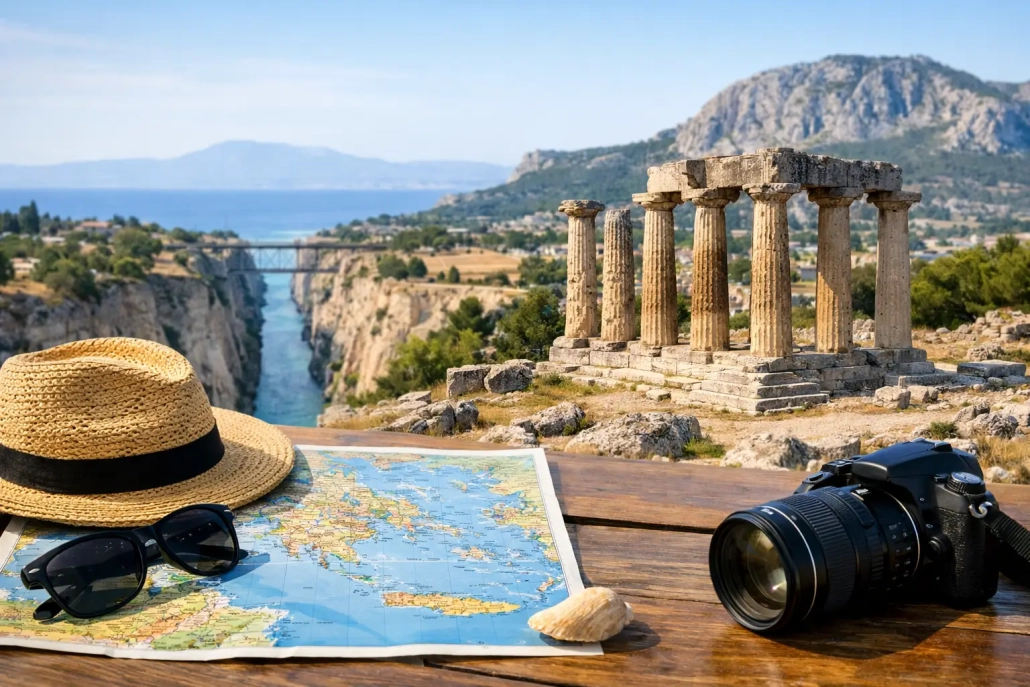
A Corinth Day Trip Itinerary From Athens
The first glimpse of the Corinth Canal is reason enough to leave Athens early. From the bridge, the narrow blue waterway appears to slice straight through the limestone, with sheer walls rising on either side. Yet the canal is only the opening act. A well-planned Corinth day trip itinerary connects one of Greece’s great engineering landmarks with the city where St. Paul preached, a hilltop fortress with sweeping views, and the relaxed coastal character of the Peloponnese.
For travelers with one free day in Athens, Corinth is an exceptionally rewarding choice. It is close enough for an unhurried private excursion, but layered enough to make ancient Greece, Roman history, Byzantine power, and modern Greek life feel vividly connected.
Why Corinth Works So Well as a Day Trip
Corinth lies about 50 miles west of Athens, usually around an hour to 90 minutes by road depending on traffic and your exact pickup point. That short distance matters. You can spend your time at the sites rather than watching the clock, and still return to Athens in time for dinner.
The region also offers more range than many visitors expect. Ancient Corinth is an archaeological site of major importance, especially for guests interested in the Roman period and early Christianity. Acrocorinth, its vast fortified acropolis, adds dramatic landscape and military history. The canal, nearby coastal stops, and the possibility of continuing to Mycenae, Epidaurus, or Nafplion make the route easy to tailor.
A private vehicle is particularly useful here because the most rewarding stops are spread across the area. Travelers can adjust the pace for children, mobility needs, photography, a long lunch, or a deeper visit with a licensed guide. Travel with the Best, don’t Guess: fixed planning and a comfortable premium vehicle remove the small logistics that can otherwise eat into a short day.
Corinth Day Trip Itinerary: A Well-Paced Full Day
This itinerary is designed for a departure from central Athens at approximately 8:00 AM. Cruise guests from Piraeus should allow additional time for disembarkation and arrange a pickup that respects the ship’s all-aboard time.
8:00 AM: Private Pickup From Athens
An early start avoids the busiest morning traffic and leaves room for a relaxed lunch. The drive west follows the coastal route toward the Isthmus of Corinth, the narrow strip of land that joins mainland Greece to the Peloponnese.
As Athens recedes, the scenery changes from city neighborhoods to sea views and low, rugged mountains. A knowledgeable local driver can point out the significance of the Saronic Gulf and explain why this narrow crossing shaped Greek trade, warfare, and travel for centuries.
9:15 AM: Stop at the Corinth Canal
The Corinth Canal is roughly four miles long, but its importance is much larger than its size suggests. Completed in the late 19th century, it created a passage between the Saronic Gulf and the Gulf of Corinth, sparing vessels the long journey around the Peloponnese.
Allow 20 to 30 minutes for the viewpoint. This is a simple stop, but it is one of the best photography moments of the day. If you are traveling with children, it is also an easy way to make the geography of Greece feel immediately real.
Some guests ask whether the canal is worth a boat ride. It can be, particularly in warmer months, but it is not essential for a first Corinth visit. A road viewpoint is efficient, while a canal cruise adds time and may reduce the time available for Ancient Corinth or Acrocorinth.
10:00 AM: Explore Ancient Corinth
Ancient Corinth is the heart of the day. In antiquity, Corinth was among the wealthiest and most powerful Greek city-states, commanding trade routes between northern Greece and the Peloponnese. Under Roman rule, it was rebuilt as a prosperous provincial capital.
The archaeological site rewards visitors who look beyond the ruins as individual monuments. The imposing Temple of Apollo dates to the 6th century BC and remains one of the earliest surviving Doric temples in Greece. Its sturdy columns stand in striking contrast to the Roman buildings around it.
The Agora, or marketplace, reveals the scale of Roman Corinth. You can see the Bema, the raised platform traditionally associated with St. Paul’s trial before the Roman governor Gallio. For many Christian travelers, this is a moving stop. The story becomes more meaningful when placed in the setting of a busy, cosmopolitan port city rather than treated as a distant religious reference.
Plan to spend at least 90 minutes here, including the on-site museum. The museum contains pottery, mosaics, sculpture, and everyday objects that give useful context to the ruins outside. Guests with a strong interest in archaeology or biblical history may prefer two hours with a licensed guide.
12:30 PM: Lunch Near Ancient Corinth or the Coast
A good Corinth day trip should not feel like a race between stones. Lunch is the moment to slow down, enjoy Greek hospitality, and discuss what you have seen. The village near the archaeological site offers traditional tavernas, while the nearby coast provides a more relaxed waterside setting.
Choose according to your priorities. A village taverna is convenient and often more traditional; a coastal lunch offers sea views and a pleasant break before the uphill visit to Acrocorinth. Fresh fish, grilled meats, Greek salad, local cheeses, and seasonal vegetables are reliable choices. If you have dietary requirements, a private driver can help plan a suitable stop in advance.
2:00 PM: Climb Into History at Acrocorinth
Rising above Ancient Corinth, Acrocorinth is one of the largest and most impressive fortresses in Greece. Its strategic position made it valuable from antiquity through the Byzantine, Frankish, Venetian, and Ottoman periods. The approach alone explains why so many powers fought to control it.
The site is expansive, uneven, and uphill. Comfortable walking shoes are essential, and the visit is best for travelers who can manage slopes and irregular stone paths. The effort is worthwhile: from the upper areas, the views extend across the Corinthian Gulf, the Peloponnese, and the plains below.
Do not expect a single polished monument. Acrocorinth is compelling because it feels like a living archive of fortification. Gates, walls, churches, mosques, fountains, and ruins from different eras appear across the hill. In summer, visit later in the afternoon only if you are comfortable with the heat. Spring and fall offer the most pleasant conditions.
3:45 PM: Choose a Flexible Final Stop
The best final stop depends on your interests and energy. Travelers who prefer a gentler finish can pause in Ancient Corinth village for coffee, browse small local shops, or enjoy a final view of the Acrocorinth hill. Those interested in engineering can return to a different canal viewpoint before heading back.
If you are building a longer private tour, this is where Corinth can become part of a larger Argolis route. Mycenae adds Bronze Age royal tombs and the Lion Gate. Epidaurus offers its famously preserved ancient theater. Nafplion brings Venetian architecture, waterfront promenades, and a charming old town. Trying to fit all of these into one rushed day, however, is rarely the best choice. Corinth deserves time on its own, while the complete Argolis route is better as a full-day private experience with an early departure.
5:00 PM: Return to Athens
The drive back is a welcome chance to rest after a day of walking and absorbing centuries of history. Depending on traffic and your chosen final stop, you can generally expect to arrive in Athens around 6:00 to 6:30 PM.
Practical Tips for Your Corinth Day Trip Itinerary
The ideal season is April through June or September through October, when temperatures are more comfortable for Ancient Corinth and Acrocorinth. July and August are still possible, but an earlier start, water, sunscreen, sunglasses, and a hat are essential. Winter visitors often enjoy fewer crowds, though weather can be cooler and wetter.
Wear supportive shoes with a good grip. Ancient Corinth is manageable for most visitors, but Acrocorinth has noticeably more demanding terrain. If mobility is limited, you can still enjoy the canal, Ancient Corinth, the museum, and scenic viewpoints while skipping or shortening the fortress visit.
For a private tour, decide before departure whether your priority is archaeology, biblical history, scenery, food, or a combination. This gives your driver and guide the chance to shape the day around what will matter most to you. Timeless Athens Tours can arrange a private Corinth experience with comfortable Mercedes transportation and the flexibility to make the day feel personal rather than prepackaged.
Corinth is most memorable when you give it room to unfold. Stand above the canal, walk where Roman merchants once gathered, look out from Acrocorinth, and let the distance between ancient ambition and modern Greece feel surprisingly small.


Leave a Reply
Want to join the discussion?Feel free to contribute!