
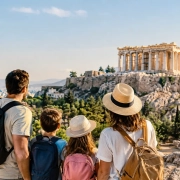
A Family Athens Itinerary for 3 Easy Days
Athens works beautifully for families when you resist the urge to see every ruin in one afternoon. The Acropolis deserves attention, but so do a shady square, a snack break with warm koulouri bread, and enough space for children to ask why Athena and Poseidon competed for the city. This family Athens itinerary balances the big-name sights with manageable distances, reliable rest stops, and the flexibility that makes a vacation feel like a vacation.
For most families, three full days is the sweet spot. You can experience ancient Athens without exhausting younger travelers, while grandparents and teens have time to enjoy the city at a comfortable pace. Private transportation is especially valuable in summer heat, with strollers, or when your group includes different energy levels.
Day 1: Acropolis, Acropolis Museum, and Plaka
Begin early at the Acropolis. Morning is not simply more pleasant – it is a practical advantage. The hill has little shade, the marble paths can be slippery, and crowds build quickly. An early private pickup from your hotel lets your family arrive with energy rather than spend it navigating traffic, ticket lines, and uphill walks.
The Acropolis is much more rewarding when its stories are made clear. A knowledgeable guide can turn the Parthenon from a famous photograph into a family conversation about Athena, ancient democracy, theater, and the remarkable engineering behind a building that has stood for nearly 2,500 years. Children do not need a lecture. They need a story, a few vivid details, and time to look around.
Plan for approximately 90 minutes to two hours on the hill, depending on the ages and mobility of your group. Comfortable non-slip shoes, water, hats, and sunscreen are essential. Families traveling with a stroller should be aware that the Acropolis terrain is not ideal for it; a baby carrier is often the easier choice.
Good to know: children and teenagers under 18 enter the Acropolis free, and the hill opens at 8:00 every day. See our guides to Acropolis opening hours and tickets and visiting the Acropolis with children.
Let the museum bring the ruins to life
After the Acropolis, continue to the Acropolis Museum while everyone still remembers what they saw above. Its bright galleries, glass floors, and original sculptures give children useful context without requiring another long outdoor walk. The top-floor Parthenon Gallery is particularly effective because it aligns visually with the monument itself.
Pause for lunch before moving on. A long, formal meal may not suit every family after a busy morning, so choose a relaxed taverna where you can share familiar favorites such as grilled chicken, meatballs, Greek salad, pita, and fries. Greek dining is family-friendly by nature, but an earlier lunch usually means faster service and calmer tables.
Spend the later afternoon in Plaka, Athens’ historic neighborhood below the Acropolis. Its narrow lanes, small shops, and colorful corners are easy to enjoy without an agenda. The nearby Anafiotika district feels almost like a tiny Cycladic island village tucked into the city. Keep expectations realistic here: the lanes are charming but steep in places, and there is no need to cover every street.
Day 2: Ancient Athens with room to play
The second day of your family Athens itinerary should reveal the city beyond the Parthenon. Start at the Ancient Agora, once the civic and commercial heart of Athens. This site has open space, memorable ruins, and the exceptionally well-preserved Temple of Hephaestus. For children, it is easier to picture daily life here than at some larger archaeological sites: people shopped, debated, met friends, and made decisions that shaped the ancient world.
The Stoa of Attalos museum is compact and worthwhile, particularly if your family enjoys artifacts such as coins, pottery, tools, and toys. It also offers welcome relief from the sun. A guide can tailor the visit around what interests your children, whether that means mythology, warriors, daily life, or the origins of democracy.
From the Agora, take a relaxed walk toward Monastiraki. This area is lively and can be crowded, but it gives families a taste of modern Athens: market stalls, street musicians, souvenir shops, and striking views toward the Acropolis. It is a good place for a quick snack or a frozen yogurt stop.
Choose one afternoon experience, not three
Afternoons are where many itineraries go wrong. Families often schedule too much after a demanding morning, then find themselves rushing through attractions when everyone needs a break. Choose one of these directions based on your group.
For younger children, the National Garden near Syntagma Square provides shade, paths, and a welcome change of pace. You can pair it with the ceremonial changing of the guard outside the Greek Parliament, which is brief, unusual, and often more engaging for kids than another museum.
For older children and teenagers, the Panathenaic Stadium is a stronger choice. This marble stadium hosted the first modern Olympic Games in 1896, and its scale makes an impression. Teens can appreciate the Olympic connection, while younger visitors enjoy imagining athletes racing on the track.
Families with a serious interest in mythology may prefer the Temple of Olympian Zeus and nearby Hadrian’s Arch. The remaining columns are dramatic, but this is a shorter stop rather than a half-day activity. It works best when combined with a drive through central Athens and a leisurely return to your hotel before dinner.
Day 3: See the city comfortably, then go beyond it
On your final day, use private transport to connect the places that are less convenient on foot. A panoramic Athens tour can include Lycabettus Hill for broad city views, the elegant neighborhoods around Kolonaki, the Presidential Mansion, the Academy of Athens, and the waterfront route toward the Athenian Riviera. A premium Mercedes vehicle offers a cool, comfortable base between stops – a meaningful benefit during hot weather or after two active days.
For many families, the best third-day destination is Cape Sounion and the Temple of Poseidon. The drive along the coast is part of the experience, passing beaches and seaside communities before reaching the clifftop temple. The setting is dramatic, the site is manageable in size, and the Poseidon story is easy for children to connect with. Late afternoon is especially appealing, though sunset departures can mean a later return for families with very young children.
If your children are fascinated by ancient warriors and legends, a longer private day trip to Corinth, Mycenae, and Nafplion may be a better fit. This is a fuller day and works best for school-age children, teens, and adults comfortable with several hours of driving. The reward is substantial: the Corinth Canal, the Lion Gate at Mycenae, and Nafplion’s graceful old town create a vivid introduction to mainland Greece beyond Athens.
It depends on your pace. Cape Sounion is the gentler option for a mixed-age family or a short stay. Corinth, Mycenae, and Nafplion offer more variety and deeper history, but require an early start and a genuine appetite for a day on the road.
Practical choices that make family travel easier
Athens is a walkable city, but walkable does not always mean easy with children. Pavements can be uneven, archaeological sites are exposed to the sun, and taxis large enough for a family plus bags are not always immediately available. Planning your sightseeing by neighborhood, with transportation for longer connections, protects your time and energy.
Summer visitors should schedule major outdoor sites before noon whenever possible. In spring and fall, midday touring is more comfortable, though the Acropolis remains busiest from late morning onward. Winter brings fewer crowds and milder temperatures, but occasional rain can make stone paths slick.
Meals also deserve a little strategy. Greeks often eat dinner later than many American families, but you do not have to follow local timing exactly. Eat when your children are hungry, ask for simple shared dishes, and build in a snack break every few hours. A tired child rarely becomes happier because the next monument is famous.
When arranging a private experience, be specific about your family’s needs. Mention stroller use, car seats, mobility considerations, food allergies, flight or cruise timing, and the ages of your children. A thoughtfully tailored route can include the essential landmarks while avoiding unnecessary backtracking. Timeless Athens Tours arranges private touring in Mercedes vehicles with experienced, English-speaking local drivers and fixed, transparent prices per vehicle, so your day follows your family rather than a bus schedule. Child seats are free; just tell us your children’s ages when you book. Our drivers are not licensed guides; licensed guides are optional, available upon request for an additional fee, and subject to availability.
Athens is not a city to rush through with a checklist in hand. Give your family time to stand beneath the Parthenon, taste something unfamiliar, hear a myth in the place it began, and rest before the next adventure. Those unhurried moments are often what children remember longest.
Only have one day? Read Athens in One Day: A Local Driver’s Plan, or see our private Athens day tours.
 Timeless Athens Tours